Holiday Entertaining With Kids:
20 Ways to Keep Everyone Happy

Holiday entertaining changes when children are on the guest list.
Without kids, you can set appetizers on the coffee table, light a few candles, and reasonably expect no one to lick the frosting off dessert before dinner.
Add children, and the operating conditions shift. Someone is starving before the food is ready. Someone else won't eat a single thing you're serving.
A four-year-old has found the presents. And a pair of six-year-olds are tearing down the hallway at speeds usually reserved for airport runways.
Chaos? It doesn't have to be. You can absolutely host a relaxed holiday gathering with kids in the mix.
All it takes is a party plan that considers your guests' ages and interests, plus a safe environment with festive food and activities for a fun time together.
Here are 20 ways to make a holiday party work for kids and grown-ups alike.
1. Find Out Who's Coming
Before you plan a single dish or decoration, find out about the youngest guests:
- How many children are coming
- Their approximate ages, and especially whether any babies or toddlers are on the list
- Food allergies or dietary restrictions (ask early, not at the door)
- How late they'll stay. Will they head home after dessert, or will you need somewhere for a sleepy four-year-old to crash at 10 p.m.?
2. Food Timing Matters
A dinner that begins at 8:30 p.m. may be perfectly civilized for adults. For a three-year-old, 8:30 is practically tomorrow.
Holidays already stretch a small child's clock. There's the long drive, the skipped nap, and the cookies someone slipped them at 3 o'clock.
By the time the roast comes out, the youngest guests may have nothing left to give.
So put out hors d'oeuvres early. Crudités work beautifully: carrot sticks, snap peas and cherry tomatoes, plus some crackers and cheese.
Set the platter at kid height, and you've bought yourself an hour of goodwill.
You don't need to serve dinner at 4:45. But if the meal will run late, feed the children a simple supper first.
Then they can join everyone for dessert, which is the part they care about anyway. Tell parents the timing ahead of time, and set up a quiet corner with books or a movie for kids who need to wind down.
Just remember that hungry, exhausted children rarely become more charming as the evening goes on. Neither do adults, for that matter.
3. Provide Separate Kid and Adult Tables
While adults enjoy cocktails and hors d'oeuvres before dinner, prepare a kid-friendly alternative nearby.
Keep the tables separate to prevent ketchup drips from coloring the evening's cheese selection. Good choices for the kid's table include:
- Cheese
- Crackers
- Fruit
- Vegetables
- Bread
- Mozzarella sticks
- Mini hot dogs
You're simply preventing hunger from becoming the evening's dominant personality.
4. Keep Kid Food Simple

Picky eaters are a real thing, as any parent will tell you. If the menu strays too far from familiar kid food, some of your youngest guests may go home hungry.
That doesn't mean you need to run a separate children's restaurant out of your kitchen.
But if your menu is adventurous, include at least one or two things most kids will recognize, chosen to fit the rest of the meal:
- Bread.
- Potatoes.
- Rice.
- Pasta.
- Fruit.
- A simple vegetable.
A holiday dinner isn't the time to find out whether your nephew is finally ready for roasted fennel. Give him a safe place to land.
5. Ask About Food Allergies Ahead of Time
When you invite families, ask the parents about food allergies. Don't assume you already know, and don't guess.
If a child has an allergy, find out exactly what they need well before the meal. Plan the menu around it and keep ingredient information handy.
Avoid casual last-minute substitutions, and take cross-contact seriously: shared cutting boards, serving spoons, and baking sheets all count.
6. Give Kids a Place Play
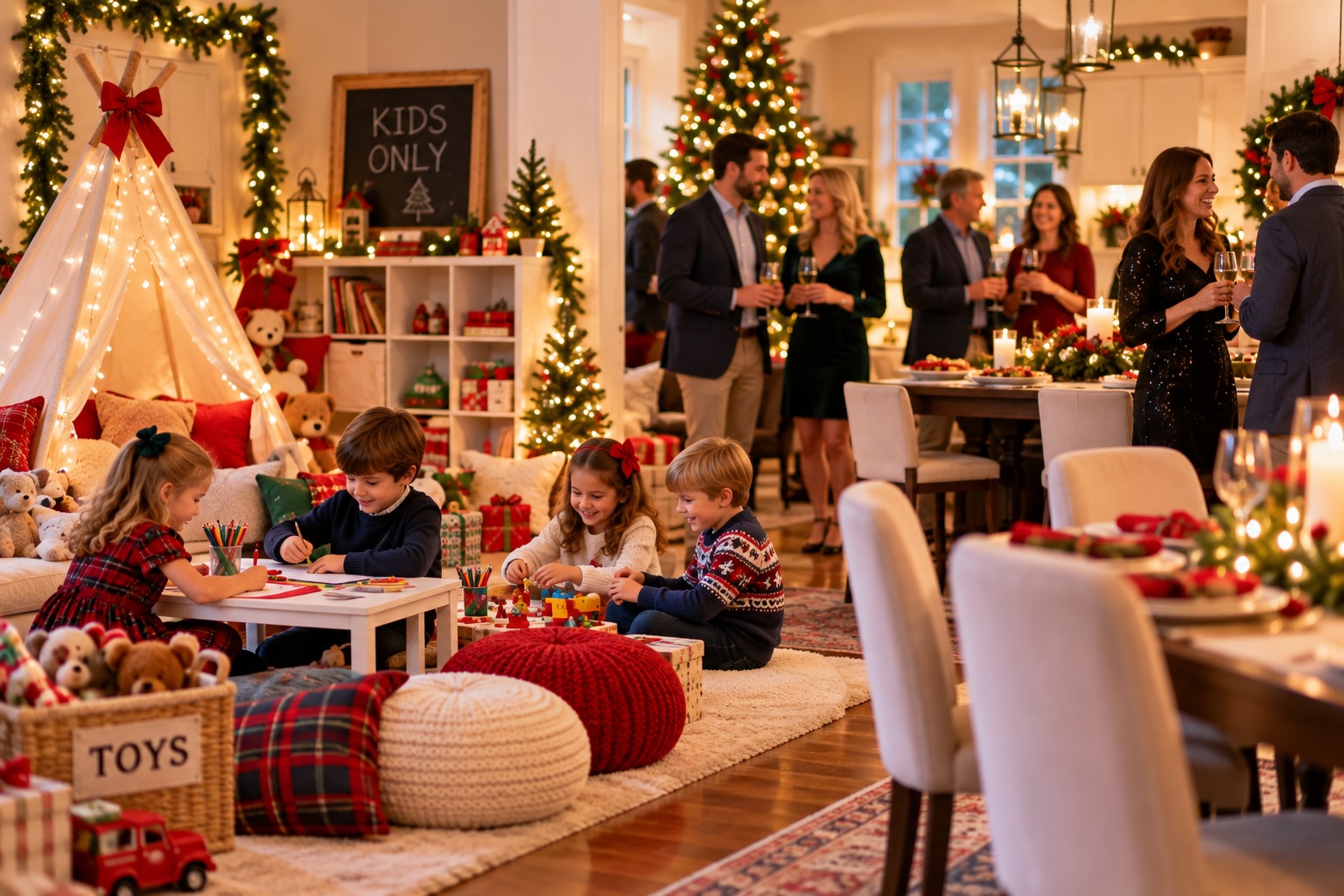
Children do much better at parties when there's a space designed for them to be kids. It might be:
- Family room
- Playroom
- Corner of the living room
- Kitchen table
- Den
- Backyard, weather permitting and with appropriate supervision
Put a few age-appropriate things there. Now the children have a destination other than directly beneath the adults' feet.
This is less “children's entertainment area” and more traffic management.
7. Toy Management Matters
More toys do not necessarily create more peaceful play. Sometimes they create 400 things on the floor. Put out a manageable selection.
Try:
- Building toys
- Cars
- Dolls
- Puzzles
- Coloring supplies
- Board games
- Books
Rotate if necessary. Your house does not need to become a pop-up toy store because children are visiting for four hours.
8. Put Away Delicate and Valuable Items
Before guests arrive, walk through the areas children will use.
Move:
- Fragile decorations
- Sentimental objects
- Breakables
- Easily tipped items
- Anything dangerous
- Anything you will become visibly upset about if a child touches it
If you leave an exquisite glass ornament at toddler eye level, you have created a test. The toddler did not agree to take the test.
9. Check the House From Kid Height
If babies, toddlers, or young children are coming, look at the rooms from their level.
Pay particular attention to:
- Stairs
- Cords
- Candles and flames
- Small objects
- Medications
- Cleaning products
- Alcohol
- Hot drinks
- Sharp objects
- Unstable furniture or decorations
- Accessible doors or pools
A house that is perfectly safe for your household may not be safe for visiting toddlers.
10. Be Careful With Holiday Decorations
Christmas decorations are understandably interesting to children. They're shiny. They're colorful. They light up. Some of them even move.
From a toddler's perspective, you have apparently redesigned the house as an interactive exhibit. To eliminate that response:
- Keep fragile or hazardous decorations out of reach of very young children.
- Secure cords appropriately.
- Consider flameless candles as an easy alternative in busy areas.
And don't assume a young child understands that one particular tree inside the house is suddenly off-limits. That's a fairly advanced botanical distinction.
11. Create One Easy Activity
You do not need to run a children's holiday camp. One simple, engaging activity is enough.
Consider:
- Coloring
- Holiday stickers
- A simple craft
- Decorating cookies
- Building with blocks
- A puzzle
- A holiday movie
- An age-appropriate game
Choose something children can do without an adult delivering a 14-minute orientation.
If the craft requires six materials, hot glue, and constant supervision, contact the neighborhood teenager about a babysitting job.
12. Skip the Glitter
This is less a suggestion than a public service announcement. Many perfectly good holiday craft supplies don't reproduce throughout the house for the next nine months.
Use:
- Crayons
- Washable markers
- Stickers
- Paper
- Precut shapes
- Washable paint, if you're feeling ambitious
Glitter has no respect for property boundaries. Once introduced, it becomes a household member.
13. Protect the Craft Surface
Before children start coloring, painting, decorating cookies, or doing any other craft, cover the table.
A vinyl tablecloth, butcher paper, an old shower curtain, or a few flattened paper bags will all work. Choose whatever you can wipe clean or throw away.
Place the supplies in the middle of the table so everyone can reach them without leaning across their neighbors. Keep paper towels, baby wipes, and a damp cloth within arm's reach.
It takes five minutes, and it's much easier than finding red marker on your dining table and then remembering that the children are "making memories."
Some memories require immediate stain treatment.
14. Give Older Kids A Job
Older children and teenagers usually aren't interested in the kids' activities, but they can be a real help.
Depending on their age and ability, they can:
- Take coats
- Set the table
- Put out appetizers
- Refill water glasses
- Choose the music
- Keep an eye on younger children
- Organize a game
- Take photos
A job gives them a real part in the party. That beats handing a 15-year-old a cotton-ball snowman kit and hoping she'll enjoy it. She probably won't.
15. Don't Force Kids to Perform

Children don't necessarily want to:
- Hug relatives
- Pose for 36 photographs
- Sing for the room
- Demonstrate what they learned at school
- Wear the itchy sweater
- Participate in every activity
Invite. Don't turn the gathering into an audition. The holidays are more pleasant when children aren't required to produce charm on command.
Frankly, adults appreciate this policy too.
16. Have a Plan for the Television
There is no holiday law prohibiting television. A holiday movie can be extremely useful when children reach the point where organized activities stop appealing.
Choose something age-appropriate. Put out blankets. Let them settle down.
You have not failed at wholesome family entertainment because animated characters are helping for 90 minutes. Take the assistance.
17. Have a Quiet Place Ready
Parties can be a lot for some children. Have somewhere a child can retreat to with a parent or caregiver if needed.
It might simply be:
- A bedroom
- Quiet corner
- Guest room
- Den
This can also help with nursing, feeding a baby, calming an overtired child, or escaping the general holiday roar.
You don't need to label it the Holiday Emotional Regulation Suite. Just make sure there's somewhere quieter to go.
18. Make Cleanup Easy for Kids
Before the party, make it obvious where things belong.
Have:
- Toy basket
- Trash can
- Recycling bin where appropriate
- Place for art supplies
- Hamper or basket for used linens if needed
Then children can actually help clean up.
“Please put the blocks in this basket” works much better than:
“Everybody clean up!”
The second instruction has been scientifically proven to cause children to suddenly lose the ability to hear. Possibly.
19. Don't Expect the Kids to Last the Night
There is often a moment in a holiday gathering when the children are simply done.
The signs aren't subtle. Crying. Fighting. Lying underneath furniture. Asking to go home 14 times. Attempting to climb an adult. A toddler wandering through the party carrying one shoe.
This is not the moment to introduce another group activity. Let parents make the exit they need to make.
A graceful departure can preserve an otherwise lovely evening.
20. What to Put in a Holiday Kids Corner
Keep it simple. Depending on ages, consider:
- Paper
- Crayons or washable markers
- Stickers
- Books
- Blocks
- Puzzles
- Small selection of toys
- Board or card games
- Holiday movie option
That's enough. You do not need to provide twelve stations.
Before Guests Arrive: 10-Minute Safety Check
Walk through the rooms young guests will use, watching for safety issues.
Check:
- Medications are inaccessible
- Cleaning products are inaccessible
- Alcohol is appropriately managed
- Candles and flames are safely positioned
- Cords don't create obvious hazards
- Fragile decorations are out of reach
- Small choking hazards are away from young children
- Stairs and other hazards are appropriately addressed
- Exterior doors are secure as needed
- Pool or water hazards are secured
- Hot food and drinks can be served safely
- Pets have a safe place if needed
It takes a few minutes.
It can save you from spending the entire evening following a toddler around saying, “No, no, no, no, no.”
The 30-Minute Kid-Friendly Party Setup
First 10 minutes: Safety
Move breakables.
Secure hazards.
Check candles, cords, and accessible rooms.
Next 5 minutes: Food
Put together one simple child-friendly snack.
Next 5 minutes: Activity
Set out paper, washable markers, toys or a game.
Next 5 minutes: Space
Clear an area where children can play.
Final 5 minutes: Cleanup
Put out a trash can, toy basket, and cleaning cloths. Done.
You do not need to create personalized gingerbread houses. Nobody knew those were an option.
Holiday Entertaining With Kids Checklist
Before the Party
- Confirm children's ages
- Ask about food allergies
- Include familiar foods
- Choose a children's area
- Move fragile objects
- Check safety hazards
- Plan one easy activity
- Set aside a quiet space
- Decide how gifts will work
- Prepare for pets and children
- Have basic cleanup supplies ready
During the Party
- Feed kids before they're desperately hungry
- Keep hot food and drinks safely positioned
- Supervise young children appropriately
- Let activities remain optional
- Give older kids useful jobs
- Deal with spills promptly
- Allow quiet breaks
- Use a movie when everybody needs one
Before Everyone Leaves
- Do a five-minute toy cleanup
- Gather crafts
- Find gift pieces
- Check for forgotten coats and belongings
- Send children home before they completely unravel
That last one is primarily the parents' decision. But you may recognize the moment.
The Bottom Line
Successful holiday entertaining with kids doesn't require an elaborate children's program.
It requires thinking about what children actually need.
Food before they're starving.
A place to play.
Something to do.
A house that's reasonably safe.
A little freedom.
A quiet place when they've had enough.
And adults who understand that children attending a party will occasionally behave like children attending a party.
Protect the breakables.
Skip the glitter.
Put out some crayons.
Feed everyone.
Then let the evening unfold.
The kids may be loud.
Someone may spill something.
The cousins may build a fort out of your sofa cushions.
And by the end of the night, one small child may be asleep sideways across an adult who no longer has feeling in one arm.
That's not a failed holiday party. That's pretty much the real thing.
Keep Going
To make the season simpler, read Easy Christmas Holiday Tips.
Getting the house ready before everyone arrives? Easy Holiday Cleaning Tips.
Want a lower-waste gathering? See Green Holiday Entertaining.
And if you'd like the children to contribute to household life beyond December, see Chores for Kids by Age.
- Clean Home
- Family Life
- Holiday Entertaining With Kids