Organize Kids' Bedrooms Before the Holidays: Make Room for What's Coming
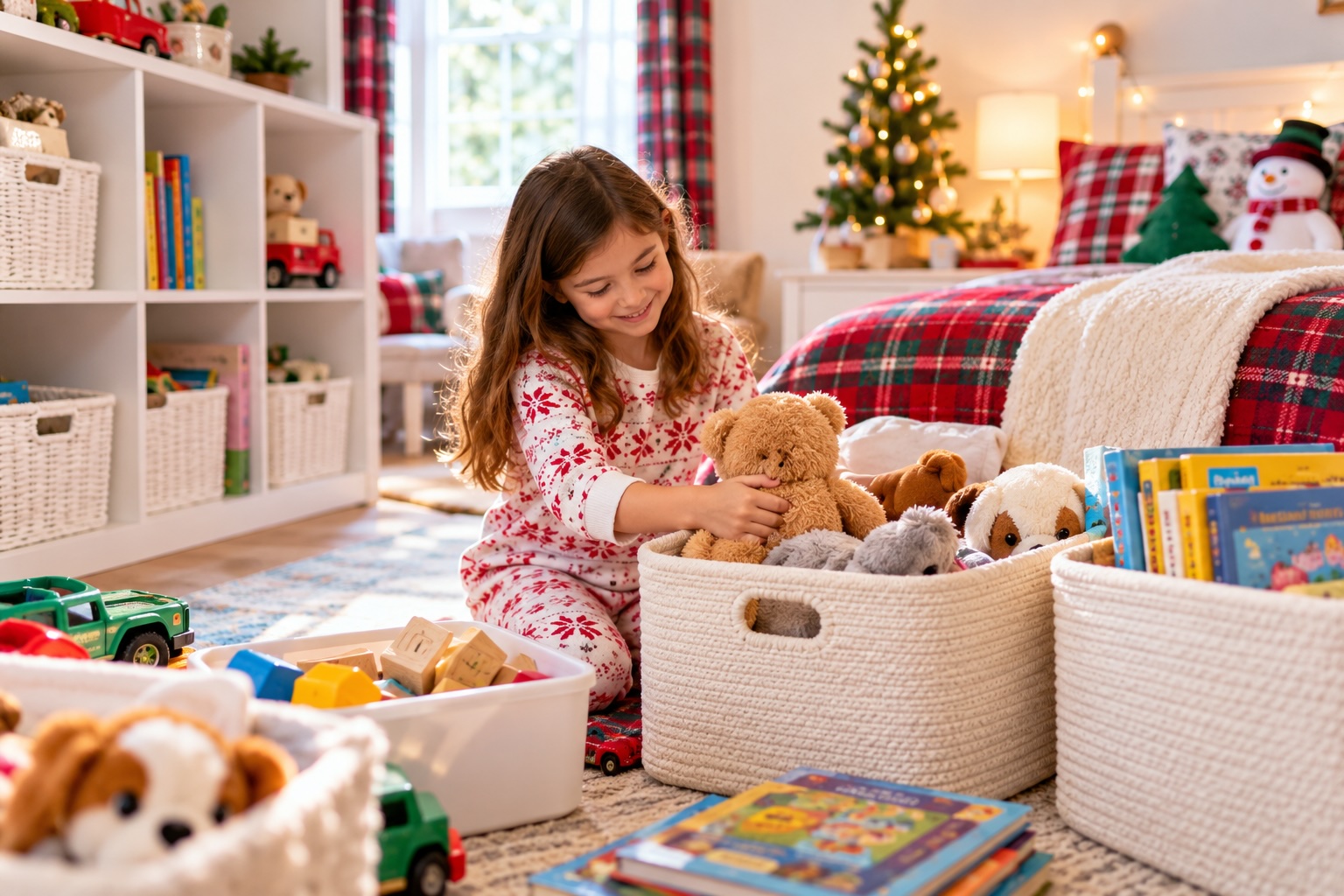
Every December, something remarkable happens in children's bedrooms. They're already full. Then Christmas arrives.
Suddenly there are more toys, more books, more clothes, more stuffed animals, and at least one enormous object that apparently requires its own zoning permit.
The solution is not to buy more storage bins. At least not yet.
Before the holidays, take a little time to clear out what your child has outgrown, stopped using, or simply no longer wants.
You're not trying to create a minimalist children's bedroom. You're making enough room for the bedroom to continue functioning after December 25.
Because adding new stuff to an already-full room isn't organizing. It's stacking.
Here's how to get ahead of it.
1. Start Before the Gifts Arrive
The best time to organize a child's bedroom is before the holidays.
Not December 26, when the floor is covered with:
- Boxes
- Wrapping paper
- New toys
- Old toys
- Instruction sheets
- Plastic pieces
- Batteries
- A stuffed animal roughly the size of Delaware
Give yourself a head start. Even one hour before Christmas can make a noticeable difference.
2. Don't Empty the Entire Room
Please don't begin by pulling everything out of every drawer, closet, and toy bin.
This creates the familiar organizing situation in which the room becomes significantly worse, everyone gets tired, and bedtime arrives while the mattress is covered in action figures.
Work one category at a time.
Try:
- Trash
- Clothes
- Toys
- Books
- Art and school supplies
- Stuffed animals
- Closet
- Surfaces
Finish one before moving to the next. Containment is our friend.
3. Begin With the Easy Trash
Start with things nobody needs to make an emotional decision about.
Look for:
- Broken packaging
- Scraps of paper
- Dried-out markers
- Obvious trash
- Empty boxes
- Broken items that can't reasonably be repaired
- Random plastic pieces nobody recognizes
Don't start with your child's beloved stuffed bear from preschool. We need an easy win first. The bear has attorneys.
4. Remove Clothes That Don't Fit
Children grow. Their closets don't automatically adjust.
Go through:
- Shirts
- Pants
- Dresses
- Pajamas
- Jackets
- Shoes
- Seasonal clothing
Pull out items that are clearly too small or that they no longer wear. Then decide what happens next:
Keep for a younger child.
Donate.
Sell.
Toss or recycle appropriately if unusable.
If you're saving hand-me-downs, label them with the size and store them somewhere appropriate.
Don't leave six years of children's clothing in the current child's closet because another human may theoretically need it someday.
Current storage should mostly serve current life.
5. Let Kids Help Decide What Goes
If your child is old enough, involve them. Don't simply disappear half the toy collection while they're at school.
That may make the room look wonderful. It can also make your child suspicious of you for the next decade.
Instead, ask simple questions:
Do you still play with this?
Would you choose this today?
Would another child enjoy this more?
Do you want to make room for something new?
Children may surprise you.
Sometimes they're much less attached to their possessions than the adults are.
6. Don't Ask About Every Single Toy
However, there is such a thing as too much participation. Holding up 173 individual objects and asking:
“Keep or donate?”
is an excellent way to spend the rest of December in one bedroom.
Group things first.
- Cars.
- Dolls.
- Building toys.
- Games.
- Craft supplies.
Then make decisions by category. It's much easier to recognize that you own 38 toy cars when they're all in the same place.
One toy car is charming. Thirty-eight constitute a transportation department.
7. Use Four Decisions
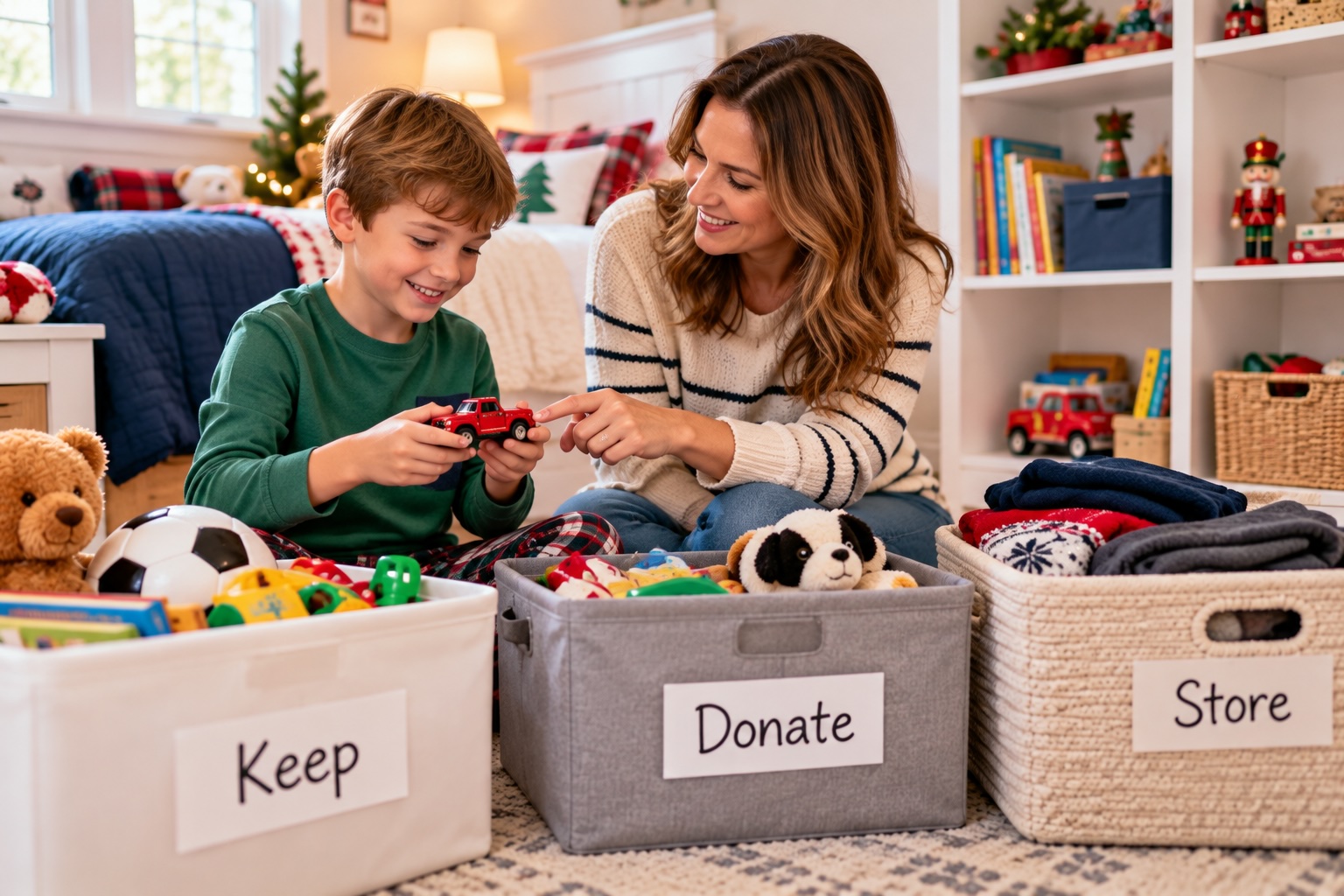
Keep the sorting simple:
KEEP
Things your child currently uses, wears, or loves.
DONATE
Good-condition things your child has outgrown or stopped using.
SELL
Items genuinely worth the time and effort of selling.
TOSS
Broken, unusable, or worn-out things that can't appropriately be donated.
That's enough categories. You don't need:
“Maybe.”
“Someday.”
“Ask Dad.”
“Possibly for cousin.”
“Could be useful for craft.”
Those are not decisions. Those are storage systems for indecision.
8. Be Ruthless About Broken Toys
Broken toys have a strange ability to remain in children's bedrooms indefinitely.
Ask:
Can it actually be fixed?
Will you actually fix it?
Does your child still want it?
If yes, repair it. If not, let it go. If you've been saying “I'll glue that later” since Easter, later has submitted its resignation.
9. Find the Toys Your Child Has Outgrown
Some toys aren't broken. They're simply finished. Your child may have moved beyond:
- Baby toys
- Preschool puzzles
- Early readers
- Simple games
- Toddler building sets
- Toys designed for earlier developmental stages
These can be wonderful donation candidates if they're in appropriate condition.
Just because your child once adored something doesn't mean the object has to stay in the bedroom forever. Its job may simply be finished.
10. Tame the Stuffed-Animal Population
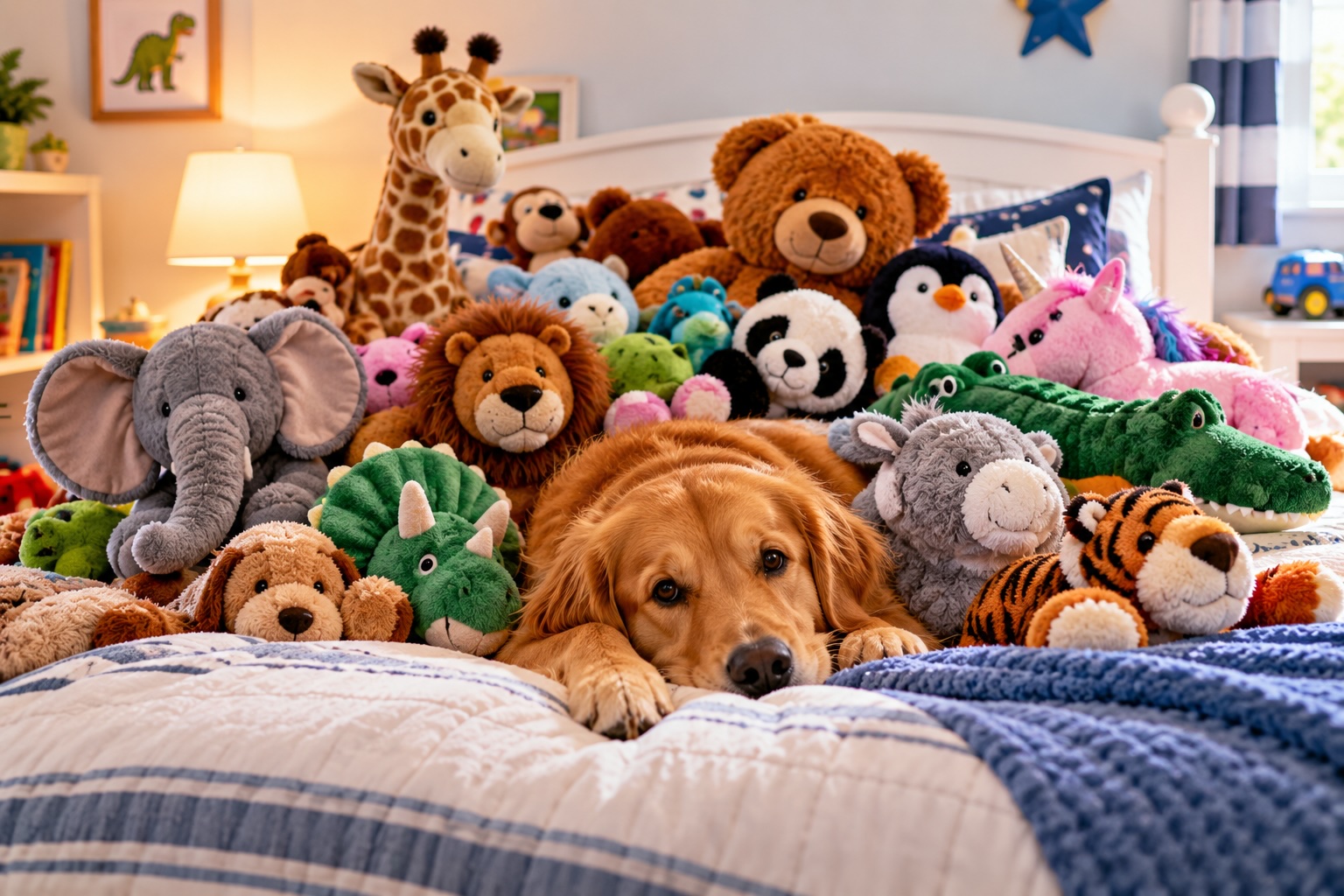
Stuffed animals tend to multiply quietly. Nobody remembers getting all of them. Yet one day you realize there are 42.
Bring them together. Let your child choose the favorites. Look for animals that:
- Are never played with
- Have been forgotten
- Are duplicates of sorts
- Are badly worn
- No longer matter to your child
Don't impose an arbitrary number if you don't need one. The goal isn't to eliminate stuffed animals.
It's to prevent the bed from becoming a wildlife preserve.
11. By the Book
Pull out:
- Books your child has outgrown
- Duplicates
- Books nobody enjoys
- Damaged books beyond reasonable repair
Keep favorites. Donate appropriate books in good condition. Then put the remaining books somewhere your child can actually reach and return them.
A bookshelf should hold books. Not books plus toys plus trophies plus six rocks plus a cup that has been missing since June.
12. Reduce Art and Craft Supplies
Children's art supplies often contain a lot of inventory with very little actual usefulness.
Check:
- Markers
- Crayons
- Paint
- Glue
- Paper
- Stickers
- Craft kits
Discard dried-out or unusable supplies appropriately. Combine duplicates where possible. Put similar items together.
You don't need seven containers holding four crayons each. This is organization, not crayon franchising.
13. Deal With Tiny Toy Pieces
Tiny pieces are where children's-room organization goes to die.
Collect:
- Building pieces
- Doll accessories
- Game pieces
- Toy food
- Miniature figures
- Puzzle pieces
Return obvious pieces to their sets. If you don't know where something belongs, give it a temporary small-parts container.
If nobody identifies or needs it after a reasonable period, reconsider whether it deserves permanent housing.
Do not dedicate half a drawer to a plastic piece whose identity has been under investigation since 2024.
14. Match the Storage to the Child
Storage only works if your child can use it. A complicated system requiring:
- Lids
- Perfect folding
- Tiny categories
- High shelves
- Adult-level precision
may look beautiful for approximately 48 hours. Then reality returns.
For younger children, simple systems usually work better:
Books here.
Blocks here.
Cars here.
Stuffed animals here.
Dirty clothes here.
That's a system a child can actually maintain. If cleanup requires a map legend, simplify it.
15. Use Open Bins for Frequently Used Toys
For toys you use often, open bins or baskets make cleanup easier.
Child takes toy out. Child puts toy back. Easy peasy. That's what we're after.
Reserve more complicated containers for things that genuinely need them. Not every Lego brick requires its own administrative district.
16. Label Where It Helps
Labels can make cleanup easier, especially on bins and drawers.
For younger children, labels can include pictures.
Useful categories might be:
- Cars
- Dolls
- Blocks
- Art
- Games
- Animals
Keep categories broad. If you have bins labeled:
Medium-Sized Plastic Animals
and
Small Non-Farm Plastic Animals
you may have gone too far.
17. Keep Everyday Things Within A Child's Reach
The things your child uses most should be easiest to access. Prime storage space belongs to current favorites.
Less-used things can go:
- Higher
- Farther back
- Under the bed, if appropriate
- In another storage area
Don't make a child climb over three boxes to reach the toys used every day.
Storage should reflect use. Not archaeological age.
18. Don't Let the Closet Become the Dumping Ground
A bedroom can look beautifully organized, but the closet is one door-opening away from an avalanche. Don't just transfer the mess.
Give the closet specific jobs:
- Current clothes
- Shoes
- A limited amount of toy storage
- Seasonal items where appropriate
If the closet holds things nobody has used in years, deal with them. A closed door is an excellent short-term cleaning technique.
It is less successful as a five-year organizing plan.
19. Clear the Floor
One of the best pre-holiday goals is simple:
Get things off the floor.
A clear floor makes a child's room:
- Easier to clean
- Easier to walk through
- Easier to play in
- Easier to maintain
It also gives new toys a temporary place to live while everyone figures out where they belong.
If you're stepping over things to reach the bed, storage has stopped doing its job.
20. Clear the Top of the Dresser
Children's dressers become collection points.
Remove:
- Outgrown clothes
- Papers
- Toys
- Cups
- Hair accessories
- Random treasures
- Things waiting to be put somewhere else
Return only what belongs there.
A mostly clear dresser makes the entire bedroom look more organized. t also gives your child one fewer place to build a new pile.
They will locate another. Children are resourceful.
21. Create a Home for New Gifts Before Christmas
This is the key holiday step. After decluttering, deliberately leave some storage space empty.
An empty:
- Bin
- Shelf
- Drawer
- Section of closet
is not wasted space. It's capacity.
Christmas is coming. Something is going to need that space. Do not immediately fill every available inch simply because you successfully created it. Empty space is doing a job.
22. Don't Buy Organizers Until You've Decluttered
This is worth repeating. Do not begin this project at the container store.
First:
Remove trash.
Remove outgrown clothing.
Remove unwanted toys.
Remove excess. Then see what remains. You may discover you already own enough storage.
Buying six bins before reducing the contents often results in exactly what you had before: Too much stuff.
Now color-coordinated.
23. Create a Donation Box Before the Holidays
Put a donation box somewhere convenient. As you organize, place appropriate items directly inside.
When the box is full, get it out of the house. Don't move it:
Bedroom → hallway → garage → car trunk → garage again.
Donation is a process with a final step. The object has to actually leave. Otherwise, you've simply reorganized the donation pile.
24. Stop When the Room Works
You don't need to create a magazine-ready children's bedroom.
Ask:
Can your child find things?
Can your child put things away?
Can you walk across the room?
Do current clothes fit in the closet or dresser?
Is there room for incoming gifts?
If yes:
Stop. Don't celebrate your success by reorganizing the sock drawer by emotional significance. You're done.
The One-Hour Pre-Christmas Kids' Room Reset
No time for a complete overhaul? Do this.
First 10 Minutes: Trash
Remove obvious trash, broken packaging, and unusable items.
Next 10 Minutes: Clothes
Pull out clearly outgrown clothes and shoes.
Next 15 Minutes: Toys
Identify toys your child has outgrown or no longer uses.
Create Keep, Donate, and Toss groups.
Next 10 Minutes: Books and Crafts
Remove outgrown books and unusable art supplies.
Next 10 Minutes: Put Things Away
Return toys, books, and clothes to their homes.
Final 5 Minutes: Make Space
Leave one shelf, bin, or other storage area available for incoming gifts. That's an enormous improvement in one hour.
Do not reward yourself by going into the sibling's room. Rest.
The 20-Minute Emergency Version
Christmas almost upon you? Fine.
Five minutes
Trash and broken items.
Five minutes
Obviously outgrown clothing.
Five minutes
Five to ten unused toys or books.
Five minutes
Clear the floor and one shelf or bin.
Done. You have created breathing room. Sometimes that's all December requires.
What to Do on Christmas Morning
Here's where your pre-holiday work pays off. As gifts are opened:
Keep one bag or box for trash.
Keep one place for recyclable materials your local program accepts.
Keep gift pieces together.
Keep instructions with the item.
Put small parts somewhere safe.
Remove unnecessary packaging.
Don't try to organize every gift immediately. Let children enjoy them. Later, new items can move into the space you already created.
This is significantly easier than standing in a completely full bedroom holding a new three-foot dollhouse and whispering:
“Where is this supposed to go?”
The One-In, One-Out Rule: Optional, Not Law
Some families like a one-in, one-out rule:
One new toy comes in, one old toy leaves.
It can work. But don't make it a rigid requirement. A child who receives four books does not necessarily need to surrender four beloved books to maintain mathematical balance.
Use the principle when it helps:
As new things come in, periodically reassess old things.
That's enough. Your child's bedroom is not an inventory-controlled warehouse.
After Christmas: The 15-Minute Gift Reset
A day or two after Christmas, do a quick pass.
Ask:
- Where will each new toy live?
- Do new clothes fit in the dresser or closet?
- Are gift boxes still needed?
- Are there duplicate gifts?
- Does your child now realize they no longer need anything?
- Are small parts contained?
- Are batteries and instructions where they belong?
Don't wait six weeks. New things develop permanent squatting rights surprisingly quickly.
What About Sentimental Toys?
Holiday decluttering can uncover sentimental things.
Baby toys. A favorite stuffed animal. A toy from a grandparent. Something associated with a particular stage of childhood.
These don't need to be treated like ordinary clutter. If something genuinely matters, keep it.
But distinguish between:
Your child loves this.
and
I remember when my child loved this.
Those aren't always the same thing.
And if the sentimental attachment is yours rather than your child's, the item may belong with your keepsakes rather than occupying prime space in the child's current bedroom.
The room needs to serve the child who lives there now.
What About Gifts A Child Doesn't Want?
This can be awkward.
If a child receives something they genuinely won't use, you don't necessarily have to give it permanent bedroom residency simply because it was a gift.
Depending on the situation, you may:
- Exchange it
- Return it
- Donate it
- Pass it along
- Keep it temporarily until an appropriate decision can be made
Teach gratitude for the person and the gesture. That doesn't require keeping every object forever.
A gift is not a lifetime storage contract.
Five Things to Organize Before Christmas
If you do nothing else, tackle these:
1. Outgrown clothes
They take up space that could be used for clothes that fit.
2. Unused toys
These are the biggest competition for incoming gifts.
3. Broken toys
They don't deserve storage.
4. Books your child has outgrown
Keep favorites; move along the rest.
5. The floor
Give the room physical breathing space.
Do those five things, and you've solved most of the immediate holiday problem.
Pre-Holiday Kids' Bedroom Checklist
Declutter
- Remove trash
- Remove broken toys
- Pull out outgrown clothes
- Pull out outgrown shoes
- Sort unused toys
- Sort books
- Check stuffed animals
- Clear unusable craft supplies
Organize
- Group similar toys
- Simplify storage categories
- Put favorite toys within reach
- Label bins if helpful
- Clear dresser top
- Clear floor
- Reset closet
- Give books an accessible home
Prepare for Gifts
- Create donation box
- Get donations out of the house
- Leave some storage empty
- Prepare a place for new clothes
- Have a plan for Christmas-morning packaging
- Schedule a quick after-Christmas reset
Don't Aim for the Perfect Kids' Room
A child's bedroom should show evidence of a child. Toys will come out. Books will migrate.
Clothes will occasionally land six inches from the hamper despite the hamper possessing a very large opening.
That's normal. The goal isn't a room that stays perfectly organized. It's a room that's easy enough to reset.
A child should be able to look around and understand:
Books go there.
Toys go here.
Clothes go there.
Trash goes out.
That's the system.
If putting the room back together requires you, three storage products, and a 40-minute sorting session, the system is too complicated.
The Bottom Line
The best time to make room for holiday gifts is before they arrive.
But don't turn it into a massive December decluttering project.
Remove what's obviously finished.
Outgrown clothes.
Broken toys.
Unused toys.
Books your child has moved beyond.
Dead markers that have somehow received permanent housing.
Then organize what's left in simple categories your child can actually maintain.
Most importantly, leave some space empty.
You don't need to know exactly what's coming.
You know something is coming.
It's Christmas.
Something with 47 pieces and no obvious storage location is already making its way toward your house.
Give it somewhere to land.
Then close the bedroom door and go enjoy December.
Keep Going
For year-round children's room organization, see Tips for Organizing Kids' Rooms.
Want children to take more responsibility for their own spaces? Teaching Kids Household Chores shows you how to teach the skills without constant reminders.
For realistic jobs children can handle at different ages, use Chores for Kids by Age.
And for simplifying the rest of the house before the holidays, see Holiday Family Cleaning.
- Clean Home
- Organize Your Home
- Organizing Kids Bedrooms