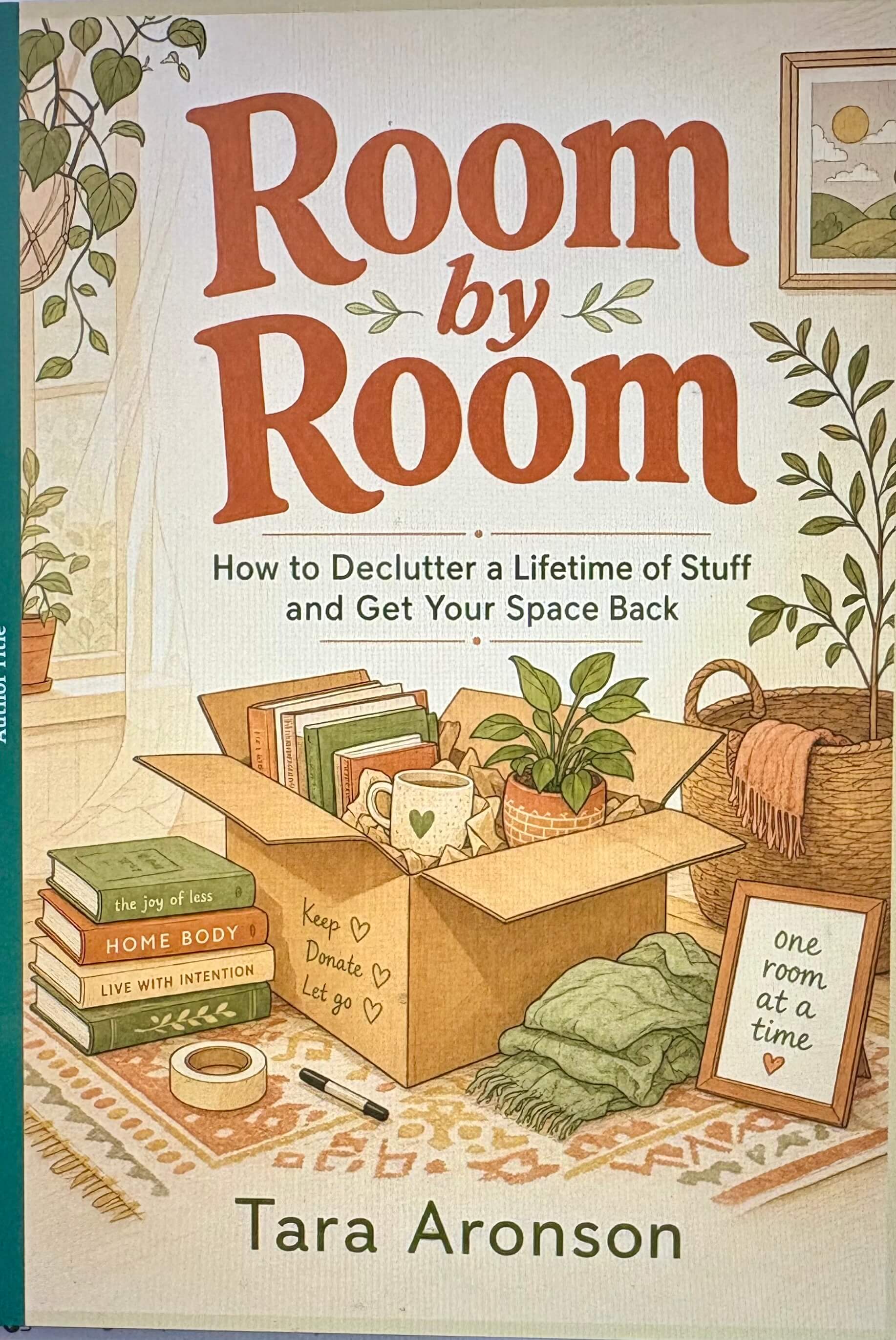
Room by Room: Declutter Your Home, Let Go of the Guilt, Get Your Space Back
Maybe you don't need another storage bin.
Maybe you need less stuff.
If you've spent years—or decades—accumulating clothes, furniture, family belongings, kitchen equipment, paperwork, gifts, keepsakes, and mysterious objects that apparently came with the house, Room by Room was written for you.
This isn't a book about becoming a minimalist.
I'm not going to tell you that six forks are morally superior to twelve.
I'm not going to ask whether your vacuum cleaner sparks joy.
And I'm definitely not going to suggest emptying the entire contents of your house onto the floor so you can spend the weekend reconsidering every decision you've made since 1997.
Room by Room is about something much more practical: getting your space back.
One room.
One decision.
One pile at a time.
When Did All This Stuff Get Here?
Usually, no single dramatic moment makes a house cluttered.
It happens gradually.
You keep the serving dishes because you might need them someday.
The kids outgrow things faster than you can decide what to do with them.
Your parents downsize, and suddenly part of their house is living in yours.
You buy replacements without getting rid of the originals.
- Things move into closets.
- Then the garage.
- Then the attic.
- Then a storage unit.
And eventually you look around and realize you're managing an enormous inventory of possessions you don't particularly want to manage.
That's where Room by Room begins.
Not with judgment.
With decisions.
This Is Decluttering for People With a Lifetime of Stuff
There's a big difference between decluttering your first apartment and decluttering a home you've lived in for twenty or thirty years.
A lifetime of belongings comes with history.
Some of it is useful.
Some of it is sentimental.
Some of it is expensive.
Some of it belonged to people you loved.
And some of it has been following you from house to house for so long that you're no longer entirely sure what it is.
That makes "just get rid of it" fairly useless advice.
Room by Room helps you make the decisions you've been postponing without turning every object into an emotional referendum.
You decide what deserves space in your home now.
The rest can leave.
The Four Decisions That Keep You Moving
When clutter gets overwhelming, complicated systems make it worse.
So the basic sorting system in Room by Room is deliberately simple:
Keep
You use it, need it, love it, or have a genuine reason to give it space.
Donate
It's useful, but it no longer needs to be useful to you.
Sell
It has enough real resale value to justify the time and effort involved in selling it.
Toss
It's broken, damaged, unusable, or simply done.
Four choices.
Not seventeen piles.
Not a "maybe" category large enough to require its own ZIP code.
Keep. Donate. Sell. Toss.
The goal is to make decisions and keep moving.
What If You're Overwhelmed by Clutter?
Then you don't start with the whole house.
You start smaller.
One room.
One section.
One drawer, if that's what you can manage today.
One of the fastest ways to derail a decluttering project is to make the starting point so enormous that you don't want to begin.
You don't need to "declutter your house."
That's much too large a job for Tuesday afternoon.
You need to clear the bathroom counter.
Or sort one shelf.
Or deal with the pile beside the bed.
Then you do the next thing.
Small decisions accumulate just as surely as clutter did.
This time, they're working in your favor.
What You'll Learn in Room by Room
Room by Room walks you through the practical and emotional problems that make decluttering difficult.
You'll learn how to:
- Decide what is genuinely worth keeping.
- Stop organizing things you should actually get rid of.
- Work through your home one manageable area at a time.
- Make faster decisions when you're stuck.
- Handle sentimental belongings without keeping everything.
- Deal with inherited and family possessions.
- Recognize the "someday" thinking that keeps things around indefinitely.
- Decide whether something is truly worth selling.
- Clear closets, kitchens, bedrooms, living spaces, garages, and storage areas.
- Stop decluttering from becoming a bigger mess than the clutter itself.
- Create systems that make it harder for clutter to return.
The objective isn't an empty house.
It's a home containing things that make sense for the life you're living now.
Because Organizing Isn't Always the Answer
This is one of the traps.
Your closet is overflowing, so you buy closet organizers.
Your kitchen cabinets are packed, so you add shelf risers.
Your garage is full, so you install more shelving.
Your storage unit is overflowing, so you buy more storage containers.
Everything becomes beautifully organized.
And you still own too much stuff.
Sometimes the problem isn't storage.
It's volume.
Room by Room helps you reduce what you're managing before you start looking for increasingly ingenious places to put it.
Once you've decided what stays, organization gets much easier.
Funny how much better things fit when half of them are gone.
What About Sentimental Clutter?
This is where decluttering advice often becomes either painfully sentimental or absurdly ruthless.
Neither is particularly useful.
You can care deeply about a person without keeping every object associated with them.
You can treasure a period of your life without preserving all the physical evidence.
And you can decide that something matters enough to keep.
The point isn't to eliminate sentiment.
It's to make deliberate choices instead of keeping things automatically because letting go feels uncomfortable.
Room by Room helps you separate the meaning from the sheer volume of objects surrounding it.
The goal isn't to become unsentimental.
It's to stop sentiment from making every decision for you.
The Things We Keep Because of Guilt
Guilt is an excellent storage salesman.
Someone gave it to you.
Someone paid good money for it.
It belonged to your mother.
You might need it.
Your children might want it.
It would be wasteful to get rid of it.
You should really use it someday.
So it stays. Year after year. Taking up space.
Guilt can make almost anything look like an obligation.
Room by Room helps you recognize those obligations for what they are and decide whether you actually want to continue paying for them—in space, time, and attention.
The "Someday" Problem
Someday is responsible for an extraordinary amount of clutter.
Someday you'll use the bread machine.
Someday you'll repair the chair.
Someday you'll fit into those jeans.
Someday you'll organize the photographs.
Someday your children will want the furniture.
Maybe.
But your home has to function today.
The book helps you distinguish a real future plan from a vague possibility that's been occupying a shelf for eleven years.
You don't have to eliminate every someday item.
You just have to stop giving imaginary futures unlimited storage space.
What About Family Heirlooms?
Family possessions can be some of the hardest things to sort because they arrive carrying expectations.
Maybe you inherited:
- China.
- Furniture.
- Jewelry.
- Photographs.
- Books.
- Tools.
- Collections.
- Boxes of family papers.
Sometimes you want these things.
Sometimes you don't.
And sometimes you feel as though not wanting them makes you the family villain.
It doesn't make the decision easy.
But avoiding the decision doesn't make the belongings disappear.
Room by Room helps you decide what you genuinely want to carry forward and what you're ready to release.
Selling Your Stuff: Is It Worth It?
Possessions have an unfortunate habit of being worth considerably more in our heads than in the marketplace.
Yes, you paid $600 for it.
No, that does not mean someone on Facebook Marketplace is eagerly waiting to give you $500.
The book helps you decide what is actually worth selling and what should simply be donated so it can leave the house.
Selling makes sense when the likely return justifies:
- Research.
- Photographing.
- Listing.
- Answering messages.
- Negotiating.
- Packing or arranging pickup.
If you're spending three weeks trying to extract $12 from an object you don't want, the object is still controlling your time.
Sometimes getting your space back is the better deal.
The Garage, Attic, Basement, and Storage Unit
These spaces are dangerous because they let you postpone decisions.
You don't have to decide whether you need something.
You just move it farther away.
Eventually, the storage area becomes a museum of deferred decisions.
Room by Room tackles these spaces differently from everyday rooms because they tend to contain a strange combination of:
- Seasonal items.
- Tools.
- Furniture.
- Childhood belongings.
- Old paperwork.
- Hobby equipment.
- Holiday decorations.
- Inherited possessions.
- Things nobody remembers putting there.
The job isn't merely to organize the boxes.
It's to determine which boxes still deserve to exist.
You Don't Have to Become a Minimalist
Minimalism works beautifully for people who want it.
But decluttering does not require adopting an entirely new identity.
You can own:
- Books.
- Collections.
- Art.
- Family photographs.
- Holiday decorations.
- Nice dishes.
- Hobby supplies.
- Sentimental objects.
You can even have a junk drawer.
Civilization will survive.
The question is whether the things you own fit comfortably into your home and contribute enough to justify the space and attention they require.
That's a much more useful standard than trying to reach some arbitrary number of possessions.
Your Home Is Not a Storage Facility
Your home has another job.
It's where you:
- Sleep.
- Cook.
- Relax.
- Work.
- Spend time with people.
- Get ready in the morning.
- Come back at the end of the day.
Every room filled with things you're storing but not using has less room available for living.
That's the real cost of clutter.
Not that the house looks messy.
That the stuff begins deciding how the house can be used.
A dining table becomes storage.
A guest room becomes overflow.
A garage stops holding the car.
A closet becomes something you open carefully while preparing to catch whatever falls out.
Eventually, you're arranging your life around your possessions.
Room by Room is about reversing that relationship.
What Happens After You Declutter?
You organize what's left.
This is the part people often try to do first.
Once you've reduced the volume, you can create simple systems based on:
- Where you use things.
- How often you use them.
- Who needs access to them.
- How easy they are to put away.
And because you're organizing fewer possessions, those systems are easier to maintain.
You aren't trying to become a professional organizer.
You're making your house easier to use.
That's the standard.
Who Is Room by Room For?
This book is for you if:
- You know you have too much stuff but don't know where to start.
- You've tried organizing, but the clutter keeps returning.
- Your closets, garage, or storage spaces are packed.
- You're downsizing.
- You've inherited someone else's belongings.
- Sentimental objects make decluttering difficult.
- You feel guilty getting rid of gifts or family possessions.
- You're tired of moving the same things from place to place.
- You want a calmer home but aren't interested in extreme minimalism.
- You want practical instructions, not another lecture about why clutter is bad.
You already know clutter is annoying.
You don't need 200 pages explaining that.
You need a way through it.
Who Wrote Room by Room?
Tara Aronson is a lifestyle expert and longtime author on cleaning, organizing, and making everyday life at home easier.
For nearly a decade, she wrote the popular “Coming Clean” column for the San Francisco Chronicle, sharing practical solutions to the cleaning, clutter, and household problems of real life.
She is the author of Simplify Your Household, Mrs. Clean Jeans’ Housekeeping with Kids, The Clean Freak Manifesto, and now Room by Room: Declutter Your Home, Let Go of the Guilt, Get Your Space Back.
Her approach has always been practical rather than perfect: less clutter, simpler systems, and a home that works for the people who actually live in it.
And no, you don't need matching storage bins to get there.nd
You Don't Need to Finish the Whole House to Feel Better
One cleared counter helps.
One functional closet helps.
One room where you can see the floor helps.
Progress changes how your home feels before the project is finished.
That's why Room by Room isn't built around one enormous purge.
You keep moving.
You make decisions.
You get things out of the house.
And gradually, the space starts coming back.
Ready to Get Your Space Back?
You don't need a perfectly organized home.
You don't need to throw away everything you own.
You don't need matching storage bins.
You need enough breathing room to use your home the way you want to use it.
That's what Room by Room is about.
Declutter your home.
Let go of the guilt.
Get your space back.
Room by Room: Declutter Your Home, Let Go of the Guilt, Get Your Space Back by Tara Aronson
Keep Reading
If you're not ready to tackle the whole house yet, start with one problem:
How to Declutter Your Home Without Getting Overwhelmed →
How to Organize Your Home Room by Room →
Garage Organization: Decluttering, Cleaning & Storage Guide →
Home Office Organization Tips →