Teaching Kids Household Chores: How to Make It Actually Work

You asked your kid to clean the bathroom. Twenty minutes later, you find a damp towel draped over the sink, a toothbrush in the soap dish and a child who swears it's done. That's not laziness. Nobody ever taught them what "clean the bathroom" means.
Kids aren't born knowing how to do chores. Neither were we. The good news: teaching a chore well, once, saves you years of reminders. Here's the method that works, step by step, plus what to do when they push back. (For which chores fit which age, see Chores for Kids by Age.)
Step 1: Pick the Right Chore
Start with a chore that fits your child's age, ability and attention span, and one that's safe for them to do alone eventually. Teach one at a time. An 8-year-old handed six new chores on the same Monday learns one thing: chores are overwhelming.
Once the first chore is automatic, in two or three weeks, add the next.
Step 2: Never Say "Clean Your Room"
Clean your room" isn't an instruction. It's a philosophical concept. Ask a kid what they did after you said it, and you'll get a blank look. What did you clean? Nothing, counselor.
Break every chore into specific steps, and tell them exactly what "done" looks like:
"Clean the bathroom sink" means:
- Put away everything on the counter.
- Spray the sink and counter.
- Wipe them with the cloth.
- Wipe the faucet until it shines.
- Hang up the hand towel.
Now "done" isn't a matter of opinion.
Step 3: Teach It With "I Do, We Do, You Do"
This is the heart of teaching any chore. It's how teachers teach reading, and it works just as well on a toilet brush.
- I do. You do the chore while they watch. Go slowly and say each step out loud: "First I put the dishes in the sink. Glasses first, then plates, then the greasy pans last." Show them where the supplies live.
- We do. You do it together. They do some steps, you do the rest, and you help when they get stuck.
- You do. They do it alone while you're nearby. Check the result, and point out one thing they did well and one thing to fix.
- It's theirs. Now it's their job. You don't need to watch anymore.
The teaching stage takes longer than doing it yourself. Much longer. It's an investment. Ten minutes of teaching now saves you a thousand hours of doing it yourself later.
Step 4: Write It Down
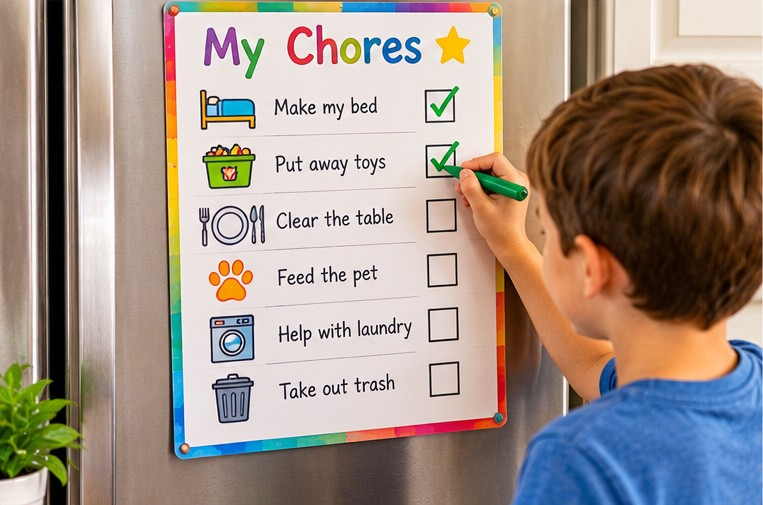
For any chore with more than three steps, make a checklist and tape it where the chore happens: inside the bathroom cabinet, on the laundry room wall, by the dishwasher. Use pictures for kids who can't read yet.
The list does the reminding, so you don't have to. And unlike you, paper has tremendous patience.
Step 5: Make the Supplies Easy to Reach (Safely)
Kids can't do a chore if they can't reach the broom. Put kid-friendly tools where kids can get them: a small broom on a low hook, a caddy of microfiber cloths and a spray bottle of plain water or mild soapy water under the sink, a stool by the counter.
Keep the strong stuff locked up. Bleach, toilet bowl cleaner, oven cleaner, drain cleaner and laundry pods belong up high or behind a cabinet lock until kids are old enough to use them with training.
Teach older kids to read labels, wear gloves, open a window, and never mix products. Bleach and ammonia together make a toxic gas. If a child swallows a cleaning product or gets one in their eyes, call Poison Control at 1-800-222-1222.
Step 6: Attach It to a Routine
Chores stick when they always happen at the same time: make the bed before breakfast, feed the dog when you get home from school, clear the table after dinner. The routine becomes the reminder. Boring is excellent. Boring means nobody's arguing about it.
What "Good Enough" Looks Like

This is where most chore teaching goes wrong, in both directions.
Don't Redo It in Front of Them
If your 7-year-old made the bed and it's lumpy, it's a made bed. Re-making it while they watch teaches them one thing: their work doesn't count, so why bother? If a chore is done to the standard you agreed on, leave it alone, lumps and all.
But Don't Accept Half a Job
The flip side: a job that isn't finished isn't finished. If the trash is out but there's no new bag in the can, calmly send them back. "You're almost done. The new bag goes in, and then you're finished." No lecture, no sighing. Just the last step.
Set the Standard Ahead of Time
Decide what "good enough" means for each chore, tell them, and stick to it. Folded towels don't need hotel corners. They need to be folded and on the shelf. The standard can rise as they get older.
Make Chores Meaningful
- Give real jobs. Kids know the difference between busywork and a job that matters. Feeding the dog, making the salad and carrying in the groceries actually help the family. Tell them so: "Because you set the table, dinner was ready 10 minutes sooner."
- Don't use chores only as punishment. If scrubbing the bathroom is what happens when you're in trouble, kids learn that chores are a penalty, not part of living in a home.
- Let natural consequences teach. If they don't put dirty clothes in the hamper, those clothes don't get washed, and the favorite jeans aren't clean for Saturday. You don't have to say a word. (Kids think the laundry might do itself if they ignore it long enough. Adults have been testing this theory for centuries.)
Should You Pay Kids for Chores?
Separate the two kinds of work:
- Family chores and personal habits (making the bed, clearing the table, feeding the pet) are unpaid. Everyone who lives here helps.
- Extra jobs (washing the car, cleaning out the garage, big yard projects) can earn money.
Paying for every single thing teaches kids to ask "What do I get?" every time you ask for help. More on allowance options in Chores for Kids by Age.
Stop Nagging: Point to the System
If you've reminded them 14 times and it isn't working, that's an excellent reason to stop trying. Instead of reminding, point to the system:
- "What's next on your checklist?"
- "It's after dinner. What happens after dinner?"
- "The chart says Thursday is bathroom day."
The chart, the checklist and the routine do the nagging, and you get to be the nice one.
Rotate Some Chores, Keep Others the Same
Keep the personal ones consistent: everyone makes their own bed and feeds their own pet, every day. Rotate the shared family chores every week or month (the bathroom, the dishes, the trash) so everyone learns everything and nobody's stuck with the toilet forever.
Add Responsibility Gradually
Teaching chores isn't a one-time event. It's a 15-year project. A 5-year-old wipes the table. A 9-year-old loads the dishwasher. A 13-year-old cleans up after dinner. A 17-year-old cooks dinner. Add a new chore, or a harder version of an old one, every few months.
The Chore-Teaching Formula
1. Pick one age-appropriate chore.
2. Break it into specific steps.
3. Show them (I do).
4. Do it together (we do).
5. Let them do it while you watch (you do).
6. Write the steps on a checklist.
7. Put the supplies where they can reach them safely.
8. Attach the chore to a daily routine.
9. Agree on what "good enough" looks like.
10. Hand it over, and add the next chore in a few weeks.
What Kids Really Learn From Chores
Persistence. Taking care of their things. That everyone in a family contributes. And how to run a home before they're on their own. That's worth every lumpy bed and soggy towel along the way.
Frequently Asked Questions
How do you teach a child to do chores?
Use "I do, we do, you do": show them the chore step by step, do it together, then let them do it alone while you watch. Write multistep chores on a checklist, and attach each chore to a daily routine.
How do I get my kids to do chores without reminding them?
Use a checklist or chore chart and tie each chore to a routine, like right after dinner. When they forget, point to the chart instead of repeating yourself.
What do you do when a child refuses to do chores?
Figure out why. If they don't know how, teach it again. If it's too big, break it down. If they forget, use a checklist. If they just don't want to, chores come before screens and playdates.
Should you redo a chore your child didn't do well?
Not in front of them, if it meets the standard you agreed on. If it isn't finished, calmly have them do the last step themselves.
How many chores should a child have?
A simple rule: divide their age by two and round up. A 6-year-old gets three chores, a 10-year-old gets five. See Chores for Kids by Age for what to assign.
Keep Going
The chore's taught and the checklist's on the wall. Keep the whole family pitching in with these related guides:
• Chores for Kids by Age: What to assign at every age, and how many chores.
• How to Get Kids to Clean Up: Toys, rooms and messes, without the yelling.
• Daily Chores for Kids by Age: The quick everyday jobs, by age and time of day.
• Weekly Chores for Kids by Age: Sheets, bathrooms, vacuuming and a sibling rotation.
• Doing Laundry With Kids: Sorting, washing, folding and putting it all away.
• Tips for Organizing Kids' Rooms: Storage kids can actually use, all year long.
• Family Meeting Rules of Order: Get everyone on board with the chore plan.
• Family Life Guide: Chores, routines and kids' rooms that keep the whole house running.
As an Amazon Associate, I earn from qualifying purchases.
To see which jobs children can handle at different ages, visit Chores for Kids by Age.
For keeping kids' bedrooms functional, visit our Tips for Organizing Kids' Rooms.
For family routines and household life, visit our Family Guide.
- Clean Home
- Clean
- Teaching Kids Chores