How to Keep Holiday Greenery Fresh Throughout the Holidays

Fresh holiday greenery is one of the easiest ways to make a house look like Christmas has arrived.
A wreath on the door. Evergreen branches across the table. A few sprigs tucked into a centerpiece.
Maybe a swag somewhere that looked tasteful when you put it up and has since expanded into a small forest.
The trouble is that fresh greenery has one rather significant design flaw: It is no longer attached to a tree.
The moment you cut evergreen branches, they begin losing moisture.
Indoors, warm rooms, fireplaces, heating vents, and sunlight can speed things up considerably.
What began December looking lush and green can end up looking like something you should approach with a dustpan.
Fortunately, where you put fresh greenery—and how you handle it before and after decorating—can make a real difference.
Here's how to help wreaths, swags, branches, and other fresh holiday greenery stay attractive for as long as possible.
1. Start With the Freshest Greenery You Can Find
Longevity starts before the greenery enters your house. Look for foliage that is:
- Richly colored
- Flexible rather than brittle
- Firmly attached to the branches
- Fresh-smelling
- Not already shedding heavily
Run your hand gently along a branch. A few loose needles aren't necessarily alarming.
A branch that immediately undresses itself is.
No amount of misting will turn already-dry greenery back into fresh greenery. Choose well at the beginning.
2. Know What Kind of Greenery You're Buying
“Christmas greenery” can mean many different plants. Common choices include:
- Fir
- Pine
- Cedar
- Juniper
- Spruce
- Cypress
- Holly
- Boxwood
- Magnolia
- Eucalyptus
They don't all behave the same way after cutting.
Some hold their needles and appearance better indoors than others. Some are better suited to outdoor displays. Some wilt rather than shed.
If you're buying greenery from a nursery, florist, or tree lot, ask what it is and how well it holds indoors.
This is particularly useful if you're planning to decorate early. December is long.
Your centerpiece needs to know what it has signed up for.
3. Buy Greenery as Late as Practical
If you want fresh greenery to look its best for Christmas, don't buy it as soon as possible.
Fresh-cut material has a limited lifespan.
If you're decorating very early in the season, consider using artificial greenery in hotter or harder-to-reach areas and saving fresh greenery for later.
There's no award for having the first wreath on the block.
And if there were, it probably wouldn't be worth sweeping needles for five weeks.
4. Keep It Cool Before You Decorate
If you're not using the greenery right away, keep it in a cool, sheltered spot. Avoid leaving it:
- In direct sun
- Beside a heater
- In a hot car
- In a warm indoor room unnecessarily
Protect it from conditions that dry it out too quickly.
If you're storing greenery temporarily outside, protect it from weather extremes and follow the supplier's advice for that plant material.
The basic principle is simple: Cool generally beats hot.
Your greenery would prefer not to spend three days acclimating beside the furnace before its official debut.
5. Give Cut Stems Access to Water
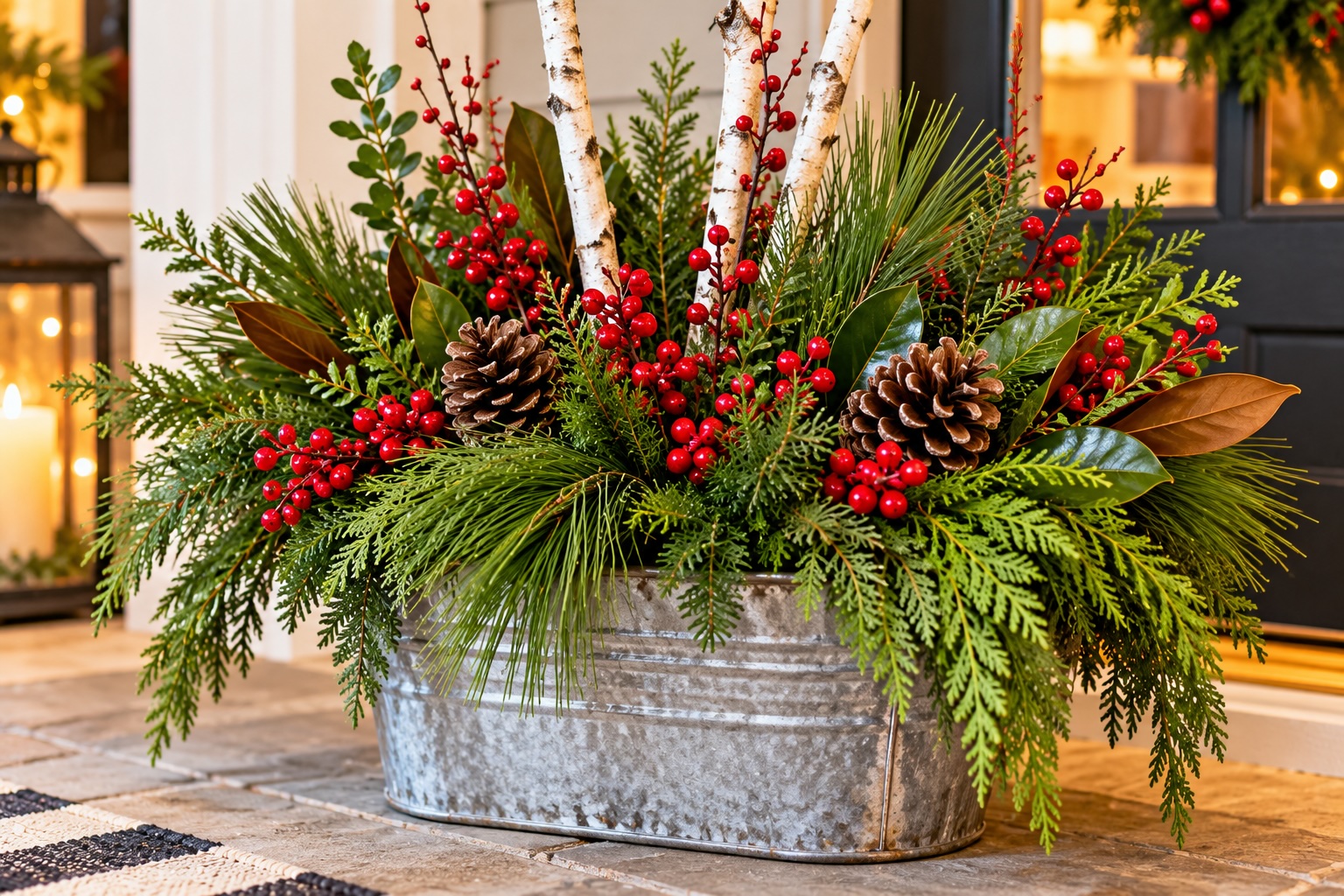
Loose evergreen branches used in arrangements can often be treated much like other cut plant material. If the design allows it, recut the stems and place them in clean water.
For container arrangements, check the water regularly and replenish it as needed.
Don't assume that because evergreen foliage still looks green, the container hasn't gone dry.
A centerpiece can be surprisingly thirsty while maintaining a very convincing poker face.
6. Condition Loose Branches Before Arranging Them
If you've bought or cut loose evergreen branches, prepare them before arranging.
Remove damaged material. Make a fresh cut at the stem end with an appropriate clean tool.
Then, if the arrangement allows, get the cut ends into water promptly. Give the greenery time to take up water before moving it into a warm room.
This won't make a cut branch immortal. It simply gives it a better start. We are improving the odds, not reversing botany.
7. Keep Fresh Greenery Away From Heat
This is one of the biggest factors indoors. Avoid placing fresh greenery directly beside or above:
- Heating vents
- Radiators
- Space heaters
- Wood stoves
- Other strong heat sources
Warm moving air can quickly dry out greenery. That gorgeous wreath may look perfect over the heating vent.
The wreath disagrees.
8. Be Careful Around Fireplaces
Fresh greenery and fireplaces can look spectacular together. But greenery becomes increasingly combustible as it dries.
Keeping greenery at least decorations away from heat sources and maintaining at least three feet between decorations and heat sources such as fireplaces, radiators, and space heaters.
Don't allow greenery to hang into or near an active fireplace.
And don't assume greenery is safe simply because it was fresh when you installed it.
Dryness changes the situation. A mantel arrangement doesn't get permanent diplomatic immunity because it's pretty.
9. Avoid Direct Sunlight
A sunny window can create a warm, drying environment. If you're decorating indoors with fresh greenery, a cooler location out of strong, direct sunlight will generally help it last longer.
This matters particularly with delicate arrangements and wreaths displayed against sunny windows.
Sometimes the place where greenery photographs best is not the place where greenery survives best.
Christmas décor has the same problem as the rest of us. Lighting can be complicated.
10. Outdoor Greenery Usually Lasts Longer

Fresh wreaths and evergreen decorations often fare better outside in cool conditions than inside a heated home.
That's useful information when deciding where to use your best fresh pieces.
Consider reserving fresh greenery for:
- Front doors
- Covered porches
- Outdoor planters
- Window boxes
- Exterior swags
and using artificial greenery in particularly warm indoor locations.
Climate matters, of course. Outdoor greenery still has to contend with sun, wind, rain, and temperature extremes.
But in cool weather, the front-door wreath frequently has an easier life than its cousin hanging over the living-room fireplace.
11. Protect Outdoor Greenery From Harsh Exposure
Being outside doesn't automatically mean perfect conditions. Strong sun and drying winds can also pull moisture from greenery.
If possible, place wreaths and arrangements where they receive some protection.
A covered porch may preserve greenery better than a fully exposed south-facing wall, depending on your climate.
If one side of an arrangement is getting hammered by sun and wind every afternoon, don't be surprised when it ages faster than the protected side.
Plants notice real estate too.
12. Mist When Appropriate
You'll often see advice to mist fresh holiday greenery. That can be useful in some circumstances, but it isn't a universal rule.
Whether misting makes sense depends on:
- The plant material
- The arrangement
- The surrounding surfaces
- Electrical decorations
- Indoor humidity
- Manufacturer or florist instructions
Don't spray water onto electrical lights, plugs, or connections.
Don't repeatedly soak walls, woodwork, fabrics, or other moisture-sensitive surfaces.
And don't assume a quick spritz substitutes for proper hydration when cut stems can actually be placed in water.
The goal is fresher greenery. Not fresher greenery plus water damage.
13. Check Wreaths Regularly
A fresh wreath is easy to hang and forget. Don't. Every few days, take a closer look.
Check for:
- Brittle foliage
- Heavy needle loss
- Browning
- Excessive dryness
- Loose decorations
- Problems with lights or wiring
If a wreath becomes very dry, its useful decorating life is ending. At that point, the answer is not necessarily another spray bottle.
Sometimes the answer is retirement.
14. Rotate Arrangements
If one side of a wreath or arrangement gets more sunlight or drier air, occasional rotation may help it age more evenly—as long as you can move the piece safely and it makes sense for the display.
This is especially useful for tabletop arrangements.
Otherwise, one side may still be celebrating Christmas while the other has moved firmly into late January.
15. Use Water-Filled Floral Containers for Arrangements
For table arrangements made from loose cut branches, design with hydration in mind.
A container that keeps stems in water can extend the arrangement's useful life compared with simply laying cut greenery dry on the table.
Check the water frequently. Keep the container clean. Top it up as necessary.
And position it so an enthusiastic dinner guest can't send the entire forest across the table while reaching for potatoes.
16. Don't Let Floral Foam Dry Out
If an arrangement uses floral foam intended for fresh plant material, follow the product and florist instructions and keep it appropriately hydrated.
Check it regularly. Once it dries, adding water later may not restore the arrangement to its previous condition.
Also protect the furniture beneath it from moisture. The dining table should not have to sacrifice its finish for Christmas.
17. Keep Greenery Away From Candles
Do not place burning candles near fresh or dried greenery. As cut foliage loses moisture, fire risk increases.
Use flameless candles when you want the look of candlelight close to greenery. This is one of those places where fake is excellent.
Fake flame. Real greenery.
Nobody's table centerpiece catches fire. A Christmas compromise we can all support.
18. Check Decorative Lights Before Adding Them
If you're combining greenery with electric lights, inspect the lights and cords first. Don't use damaged light strings.
Use lights according to their labeling and manufacturer's instructions. Keep electrical connections dry.
CPSC advises inspecting holiday lights for broken or cracked sockets, frayed or bare wires, and loose connections, and using lights certified by a recognized testing laboratory.
Greenery should decorate the lights. It should not conceal an electrical problem.
19. Be Careful With Greenery Around Children and Pets
Not every decorative plant is appropriate for every household.
Some holiday plants and greenery can be irritating or harmful if chewed or swallowed, and berries, small decorations, wire, and other arrangement components can create additional concerns.
If you have young children or pets, identify the plants you're bringing into the home and check whether they're appropriate for your household.
Place arrangements where they can't easily be pulled down, chewed, or dismantled.
Your centerpiece should not double as the dog's holiday salad bar.
20. Don't Assume “Natural” Means Pet-Safe
Pinecones. Branches. Berries. Leaves. Natural-looking decorative materials can feel harmless because they came from a plant rather than a store shelf.
That isn't a safety guarantee. Know what's in the arrangement.
This matters especially if you're using mixed florist greenery where you may not immediately recognize every plant.
Pretty berries can especially attract the attention of children and pets. Pretty is not a toxicology classification.
21. Keep Greenery Away From Food Unless It's Suitable
Fresh greenery looks beautiful around serving platters and holiday tables. But decorative plant material isn't automatically food-safe.
Avoid placing unidentified, treated, or potentially irritating plant material where it can contact food. Be especially cautious with:
- Berries
- Sap
- Preservative-treated greenery
- Florist materials
- Artificial snow or sprays
- Decorative coatings
Use greenery decoratively around food rather than assuming it belongs in food. Your mashed potatoes do not require landscaping.
22. Be Cautious With Anti-Desiccant Products
Products marketed to reduce moisture loss from cut greenery are available, but don't assume they suit every plant or use. Follow the product label carefully.
Check whether the product is suitable for:
- The specific greenery
- Indoor or outdoor use
- Your intended location
Consider nearby children, pets, food surfaces, and decorative lights as applicable. More product isn't automatically better.
“Spray it with something” is not a horticultural principle.
23. Remove Dry Greenery Promptly
Eventually, fresh greenery stops being fresh.
Watch for:
- Significant browning
- Brittle needles
- Heavy shedding
- Very dry branches
When greenery becomes substantially dried out, remove it—especially if it's indoors or near potential heat or ignition sources.
Don't keep it hanging until February simply because removing Christmas decorations has become an emotional negotiation.
It had a good run. Let it go.
24. Don't Expect Every Variety to Last Until New Year's
Different greenery ages differently. Indoor conditions vary enormously.
A wreath on a cold porch may remain attractive far longer than loose branches in a heated living room.
So don't judge all your greenery by one piece.
And don't assume you've done something wrong if a delicate arrangement finishes its holiday career earlier than a hardy outdoor wreath.
Fresh greenery is perishable décor. That's part of the deal.
25. Use Fresh Greenery Strategically
If you love real greenery but don't love replacing it, use it where it will have the greatest impact.
Instead of filling the whole house, try:
- One beautiful front-door wreath
- A small dining-table arrangement
- A few branches in a vase
- An outdoor planter
- One fresh swag
Then use artificial greenery elsewhere if you want more.
This gives you the look and scent of fresh greens without making your entire December dependent on the moisture content of 47 branches.
Sometimes less isn't minimalism. It's just fewer needles on the floor.
How Long Does Fresh Holiday Greenery Last?
There isn't one reliable number. Longevity depends on:
- Type of greenery
- How fresh it was when purchased
- Indoor versus outdoor placement
- Temperature
- Sun exposure
- Wind
- Access to water
- Humidity
- How early it was cut
Outdoor greenery in cool, protected conditions can remain attractive considerably longer than greenery displayed in a warm, dry room.
Instead of relying entirely on the calendar, watch the greenery itself.
If it is becoming brittle, brown, and heavily shedding, it's telling you something.
Listen.
How to Keep a Fresh Christmas Wreath Looking Good
For a fresh wreath:
- Start with a fresh wreath.
- Keep it cool until you're ready to hang it.
- Choose a cool location when possible.
- Avoid direct heat.
- Protect it from intense sun and drying wind when practical.
- Check it regularly for dryness.
- Keep it away from flames and ignition sources.
- Remove it when it becomes excessively dry.
An outdoor front door is often a friendlier environment than a warm interior wall.
Unless your front door spends December baking in strong afternoon sun.
Again: location matters.
How to Keep Evergreen Branches Fresh in a Vase
If you're decorating with cut evergreen branches in a vase:
- Start with fresh branches
- Make fresh cuts at the stems
- Place stems promptly into clean water
- Keep foliage away from direct heat
- Check water regularly
- Refill as needed
- Remove branches as they deteriorate
This is one of the easiest ways to use real greenery because the stems can actually drink.
It also requires almost no decorating talent.
Branches. Vase. Christmas. Done.
How to Keep a Holiday Centerpiece Fresh
For fresh greenery centerpieces:
- Choose long-lasting greenery
- Use a water-holding container when practical
- Keep stems hydrated
- Check water frequently
- Avoid hot serving dishes immediately beside foliage
- Keep arrangements away from candles
- Keep them out of strong sunlight between meals
- Remove badly deteriorated pieces
If the centerpiece contains flowers as well as evergreens, the more delicate material may determine its lifespan.
You can also replace individual pieces rather than rebuilding the entire arrangement.
Nobody needs to know that three branches were quietly dismissed on December 19.
What Makes Holiday Greenery Dry Out Faster?
The usual suspects are:
Heat
Heating vents, radiators, fireplaces, and other heat sources.
Direct sunlight
Especially through warm windows.
Dry moving air
Heating systems and drafts can accelerate moisture loss.
Lack of water
Particularly for arrangements designed to hold water.
Starting with old greenery
You cannot recover the freshness it lost before you bought it.
Time
Eventually, nature wins. Nature has an excellent record.
Can You Revive Dried-Out Christmas Greenery?
Not really. You may be able to improve slightly wilted material in some arrangements if the stems can still take up water.
But once cut greenery has become genuinely dry and brittle, you cannot reliably restore it to fresh condition.
This is why prevention matters more than rescue.
If the needles are raining onto the floor every time someone walks past, the wreath isn't asking for hydration. It's submitting its resignation.
Fresh Greenery Safety Checklist
Before and during the holidays:
- Start with fresh greenery
- Identify unfamiliar plants
- Keep greenery away from heat sources
- Keep it away from open flames
- Inspect decorative lights
- Keep electrical connections dry
- Consider children and pets
- Avoid unidentified greenery contacting food
- Check water in arrangements
- Watch for browning and brittleness
- Remove excessively dry greenery
The Five Things That Matter Most
If you want the short version:
1. Buy it fresh.
You cannot start with dry greenery and fix it later.
2. Keep it cool.
Heat accelerates drying.
3. Give cut stems water when the arrangement allows it.
Check the water rather than assuming it's still there.
4. Keep greenery away from flames and strong heat sources.
Fresh greenery becomes dry greenery.
5. Know when it's finished.
Once it becomes brittle and excessively dry, remove it. That's the entire system.
Fresh. Cool. Hydrated where possible. Away from heat. Removed when dry.
The greenery does not require a spa treatment.
The Bottom Line
Fresh holiday greenery is beautiful precisely because it's real.
It has texture. Scent. Variation. And a lifespan.
Start with the freshest material you can find. Keep it cool before decorating. Give cut stems access to water when possible.
Protect greenery from strong heat, direct sunlight, and drying conditions.
Check wreaths and arrangements regularly. Keep them away from flames. And when they become seriously dry and brittle, take them down.
You don't have to keep every branch looking perfect from Thanksgiving through New Year's Day.
Use fresh greenery where you enjoy it most. Take reasonable care of it.
And accept that eventually the needles are going to win. They always do.
Keep Going
For the more specific challenges of keeping long evergreen garlands attractive around mantels, doors and railings, see Keeping Holiday Garland Fresh.
For more practical seasonal ideas, visit Easy Christmas Holiday Tips.
And before decorating around fireplaces, candles or crowded entertaining areas, see Holiday Safety Tips for Entertaining.
- Clean Home
- Backyard & Garden
- Keeping Holiday Garland Fresh