Laundry Chores for Kids by Age:
What Kids Can Really Help With
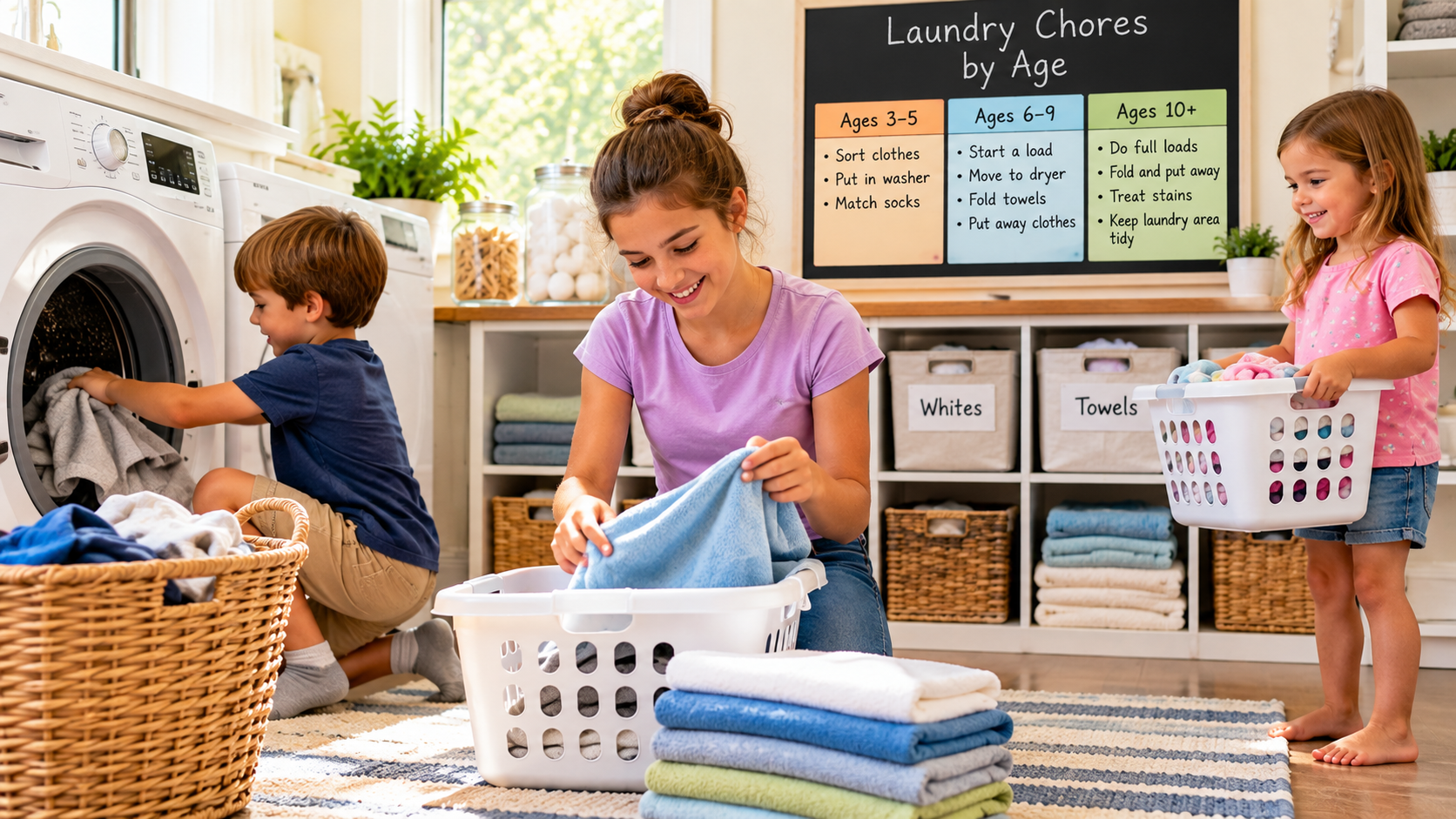
Laundry is one of those household jobs that appears to reproduce when nobody is looking.
You wash everything. You fold everything. You put everything away. Then you turn around and discover another full hamper.
Children contribute quite enthusiastically to this process, so it's only reasonable that they eventually learn how to help with it.
The good news is that kids can start participating in laundry long before they're old enough to operate the washing machine.
Start with simple jobs, add responsibility gradually, and teach each new skill before expecting your child to handle it independently.
The goal isn't perfectly folded towels. It's raising kids who eventually know that clean clothes don't magically appear in their drawers.
Start With Ability, Not Just Age
Age ranges are useful guidelines, but children develop at different rates. A chore that's easy for one 7-year-old may be frustrating for another.
Consider your child's:
- Maturity
- Coordination
- Size and strength
- Ability to follow directions
- Familiarity with the task
- Safety around your particular appliances
Supervise new chores until you're confident your child can handle them safely. And remember: teaching laundry is a progression.
You don't hand a preschooler a bottle of detergent and wish everyone luck.
Ages 2–3: Start With the Basics
Toddlers love helping. Admittedly, their definition of "helping" may differ somewhat from yours.
Still, this is a great age to introduce the idea that dirty clothes go somewhere specific.
Laundry Chores for Ages 2–3
Young children can help:
- Put dirty clothes in the hamper
- Carry lightweight clothing to the laundry area
- Put socks into a basket
- Match obvious pairs of socks
- Help move clean clothes into a basket
- Put simple clothing items into low drawers
Keep instructions short. Instead of saying, "Help me with the laundry," say:
"Put your socks in this basket."
One job. One goal. Success. Don't worry about speed or perfect results. At this age, you're building the habit of participating.
Ages 4–5: Sorting and Putting Away
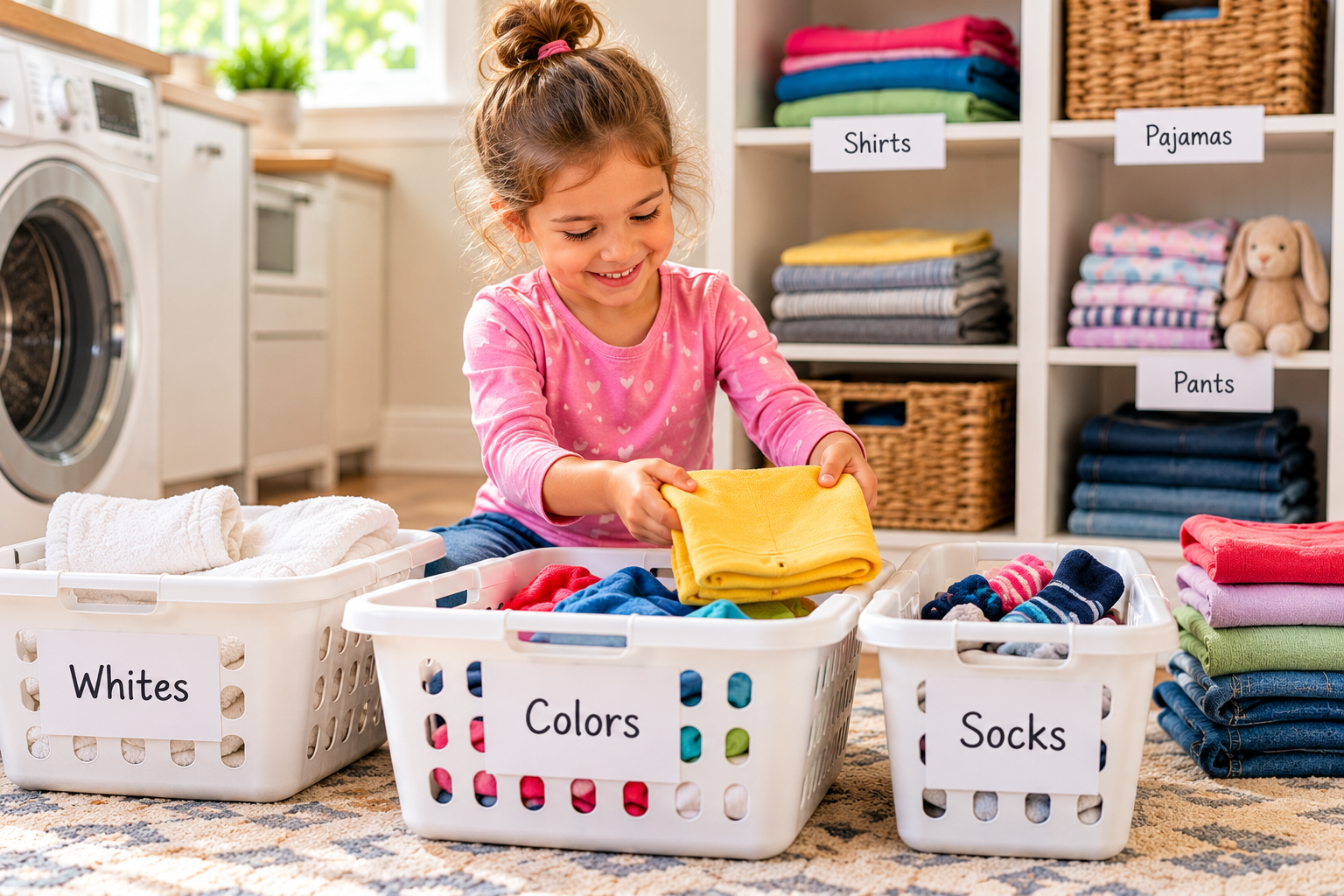
Preschoolers and kindergarten-age children can begin taking more responsibility for their own clothes.
Laundry Chores for Ages 4–5
Depending on the child, they may be able to:
- Put dirty clothes in the hamper
- Help sort laundry
- Match socks
- Fold washcloths
- Fold small towels
- Put underwear and socks into drawers
- Carry lightweight laundry baskets
- Help put clean clothes away
This is also a good time to start teaching a basic lesson:
Not everything lying on the floor is automatically dirty.
Sometimes the sweatshirt worn for 11 minutes can go back in the closet. A revolutionary concept.
Ages 6–8: Learn Simple Laundry Skills
Elementary-age children can begin doing more of the actual laundry routine. They may still need supervision, especially around machines and laundry products.
Laundry Chores for Ages 6–8
Kids this age may be ready to:
- Sort lights and darks
- Separate towels from clothing
- Check pockets
- Turn clothes right-side out
- Zip zippers when appropriate
- Match socks
- Fold towels
- Fold simple clothing
- Hang shirts
- Put clean laundry away
- Help load the washer
- Help transfer clothes to the dryer with supervision
Teach them to check pockets every time. Because crayons, tissues, gum, coins, and miscellaneous treasures do not improve during a wash cycle.
Especially tissues. One forgotten tissue can make an entire load look as though it survived a small indoor snowstorm.
Ages 9–11: Take Responsibility for a Load
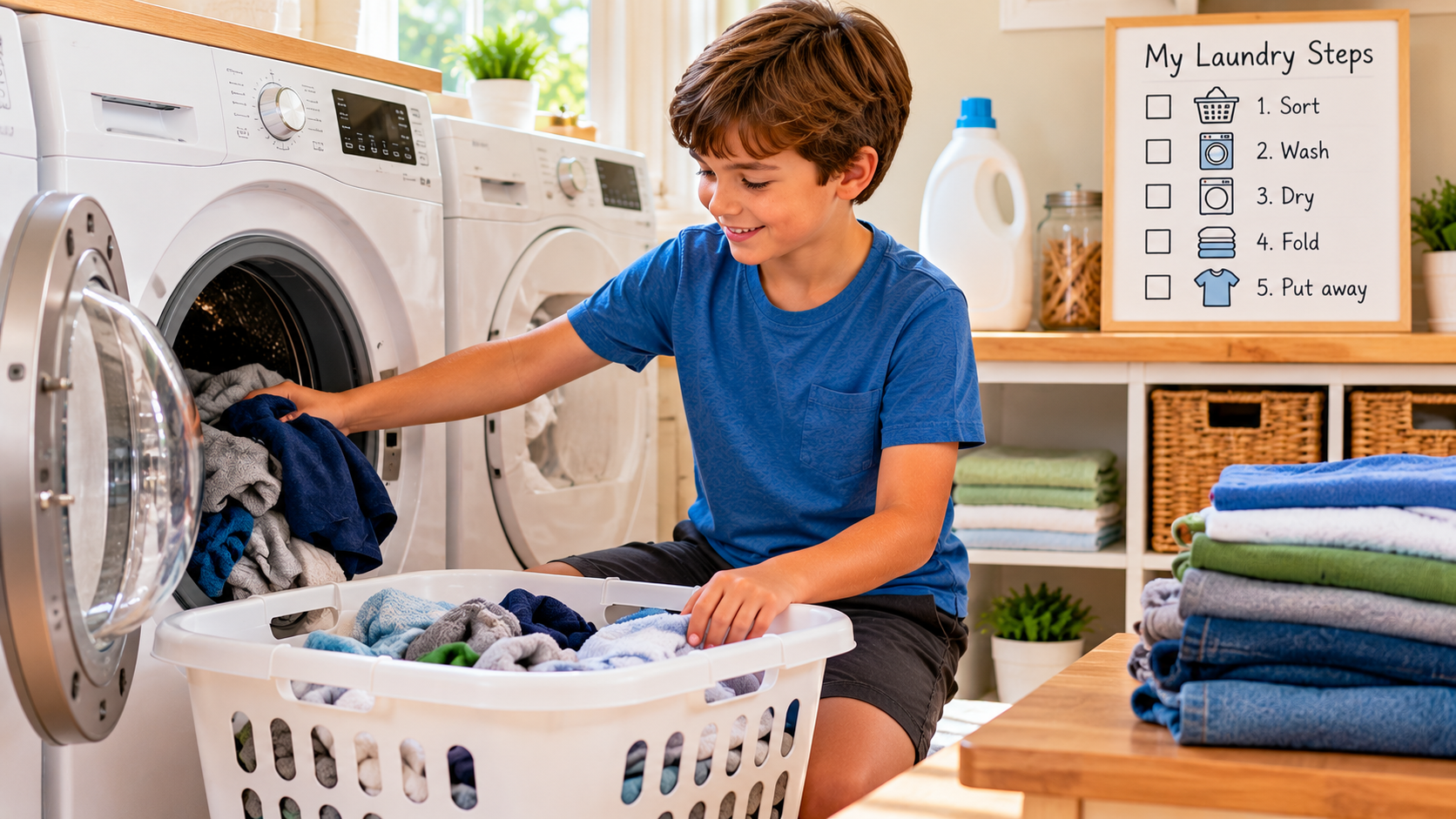
By this age, many kids can begin learning how to handle a basic load of laundry with supervision. Don't assume they automatically know how. Show them.
Laundry Chores for Ages 9–11
Depending on maturity and your machines, children may learn to:
- Sort laundry
- Read clothing-care labels
- Check pockets
- Pretreat simple stains with supervision
- Load the washing machine
- Measure or use the correct amount of detergent
- Select the appropriate washer cycle
- Transfer clothes to the dryer
- Select an appropriate dryer setting
- Hang clothes that shouldn't go in the dryer
- Fold a complete load
- Put laundry away
Teach one step at a time. You don't need to deliver a 45-minute seminar titled Modern Fabric Care and Its Consequences.
Do a load together. Explain what you're doing while you do it. Then gradually let your child take over.
Ages 12–14: Handle Their Own Laundry
Middle-school-age kids are usually capable of taking substantial responsibility for their clothing. This is an excellent time for them to learn the entire process.
Laundry Chores for Ages 12–14
They may be able to:
- Sort their own laundry
- Read care labels
- Pretreat common stains appropriately
- Choose water temperatures
- Choose wash cycles
- Measure detergent
- Wash their clothes
- Transfer loads promptly
- Use the dryer appropriately
- Air-dry delicate items
- Fold or hang clothing
- Put everything away
- Clean the lint filter as directed for your dryer
At this point, consider assigning a regular laundry day. If your child's favorite shirt isn't clean because it remained on the bedroom floor instead of reaching the hamper?
Natural consequences have entered the chat. You don't necessarily need to run an emergency laundry service.
Ages 15–18: Laundry Independence
Teenagers should leave home knowing how to wash their own clothes. This is not advanced domestic knowledge. It's survival.
Laundry Chores for Teens
Older kids should learn how to:
- Wash different types of clothing
- Read and follow care labels
- Treat stains
- Separate items when necessary
- Choose washer and dryer settings
- Avoid overloading machines
- Use the correct amount of detergent
- Handle delicate clothing
- Wash towels and bedding
- Clean the lint filter
- Keep the laundry area reasonably tidy
- Notice when laundry supplies are running low
They should also understand what not to do.
For example: Don't wash a red towel with a load of white shirts unless you're hoping everyone suddenly needs pink clothing. Don't put everything in the dryer on maximum heat.
And don't leave wet laundry in the washing machine for three days and then wonder why it smells peculiar. These are valuable life lessons.
Teach Kids to Read Clothing-Care Labels
Care labels aren't decorative tags manufacturers sew into clothes specifically to annoy us. They contain useful information.
Show older children how to check instructions for:
- Washing
- Water temperature
- Bleaching
- Drying
- Ironing
- Special care
They don't need to memorize every laundry symbol immediately. They just need to develop the habit of checking before washing something unfamiliar.
When in doubt, ask. That's considerably cheaper than discovering that a favorite sweater now fits the family hamster.
Teach the Right Amount of Detergent
Kids often assume more detergent means cleaner clothes. Adults sometimes assume this too.
It doesn't.
Teach children to follow the detergent manufacturer's directions and use an amount appropriate for the washer, load, water conditions, and soil level.
Laundry detergent should also be handled and stored according to its label. Pods and concentrated detergents require particular care and should be kept securely away from younger children.
Laundry is a chore. Laundry-product poisoning is not part of the lesson.
Make Checking Pockets Part of the Routine
Before anything goes into the washing machine: Check the pockets. Every time.
You may find:
- Money
- Tissues
- Pens
- Crayons
- Gum
- Rocks
- Toys
- Notes
- Objects nobody can explain
Make pocket-checking the responsibility of the person whose clothes are being washed as kids get older.
Eventually, they'll learn. Possibly after washing a pen. Some lessons arrive in blue ink.
Teach Kids How to Handle Stains
Older children should know that stains are usually easier to treat before clothing goes through the washer and dryer.
Teach them to tell you about stains rather than quietly dropping the item into the hamper.
Show them how to identify what caused the stain and follow appropriate stain-removal and clothing-care instructions.
And teach them one extremely useful rule:
Don't automatically put a stained item into the dryer if the stain is still visible.
Heat can make some stains harder to remove.
Check first. Dry second. Celebrate later.
Make Putting Clothes Away Part of Laundry
Laundry isn't finished when the dryer buzzes. This fact may come as disappointing news to children.
Clean laundry still needs to be:
- Folded
- Hung
- Sorted
- Put away
If kids are responsible for laundry, include this part too. Otherwise, you've simply moved the clothing pile from the floor to a basket.
Technically cleaner. Not particularly more organized.
Create a Simple Laundry Routine
Children do better when laundry happens predictably. Depending on your household, you might assign each older child a laundry day.
For example:
Monday: Parent laundry
Tuesday: Older child
Wednesday: Towels
Thursday: Younger child's clothes
Friday: Bedding
Your schedule doesn't need to look like this. It simply needs to work for your family.
Predictable routines reduce the Sunday-night announcement:
"I need my uniform clean for tomorrow."
Wonderful information. Thank you for sharing it at 9:17 p.m.
Why Kids Should Learn to Do Laundry
Laundry chores aren't simply a way to get some work off your plate. Although, eventually, that's certainly a nice bonus.
Kids who learn to do laundry are learning:
- Responsibility
- Organization
- Time management
- Clothing care
- Independence
- How to contribute to a household
These are skills they'll need whether they eventually live in a dorm, apartment, house, or extremely well-organized castle.
The goal is simple:
By the time kids leave home, they should know how to get dirty clothing from the hamper, through the washing process, and back into the closet without requiring technical support from Mom.
That's a life skill worth teaching.
Keep Going
Once kids begin helping with laundry, it's a natural time to give them a little more responsibility around the house.
Getting Kids to Clean
Teach kids how to tackle everyday cleaning jobs without turning every chore into an argument.
Teaching Kids Household Chores
Build age-appropriate household responsibilities and help kids learn the skills they'll need as they become more independent.
How to Organize Clothes
Create simple systems for closets and drawers so clean laundry actually has somewhere to go.
Laundry Cleaning and Stain Removal
Find practical help with washing clothes, treating stains, caring for fabrics, and solving everyday laundry problems.
Weekly Cleaning Checklist
Give the whole family a simple routine so cleaning doesn't fall entirely on one person. The goal isn't to turn your children into household staff.
It's to raise people who know how to take care of themselves—and who someday won't call you from college to ask which machine is the washer.
- Clean Home
- Laundry Tips & Techniques
- Laundry Chores For Kids By Age