How to Spring Clean Like a Professional

Professional cleaners know something the rest of us tend to forget:
The goal is to clean the house, not spend the entire weekend proving how hard you worked.
They don't stand in the middle of the living room wondering where to begin.
They don't reorganize a drawer halfway through cleaning the kitchen.
They don't discover an old photo album under the bed and disappear into 1997 for forty-five minutes.
They have a plan.
And while you may not clean houses for a living, you can borrow the techniques that make professionals faster and more efficient.
Because spring cleaning should leave you with a cleaner house. Preferably while you still have some spring left.
Here are 15 professional cleaning habits worth stealing.
1. Declutter Before You Clean
You cannot efficiently clean a surface you can't reach.
Before the serious cleaning starts, remove the obvious clutter.
You don't have to organize your entire house.
Just deal with things sitting where they don't belong:
- Clothes
- Shoes
- Toys
- Dishes
- Trash
- Bags
- Random household objects
Put obvious things away.
Throw away trash.
Set aside donations.
If something requires a complicated decision, don't let it derail the cleaning session. Put it in a designated decision spot and keep moving.
Professional cleaners clean.
They don't spend twenty minutes deciding whether you still have an emotional attachment to a bread maker.
If clutter is the larger problem, start with our Decluttering Guide.
2. Gather Your Cleaning Supplies First
Nothing slows cleaning down quite like walking to another room every four minutes.
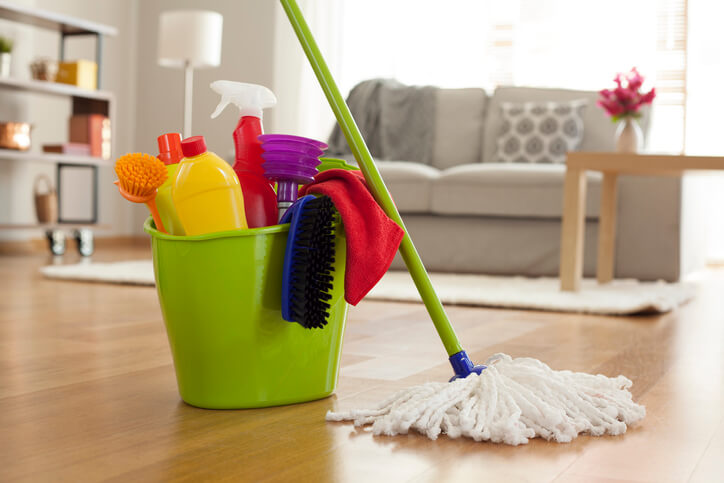
Before starting, gather the supplies you expect to need.
Depending on the jobs you're doing, that might include:
- Microfiber cloths
- Cleaning products appropriate for your surfaces
- Vacuum and attachments
- Mop
- Bucket
- Scrub brushes
- Sponges
- Duster
- Trash bags
- Protective gloves when appropriate
A cleaning caddy can make moving supplies from room to room easier.
But don't turn “assemble cleaning supplies” into its own home-organization project.
You need a few products and some cloths.
You do not need to alphabetize the spray bottles.
Stock Your Spring-Cleaning Toolkit
Deep cleaning goes faster when you aren't stopping every ten minutes to hunt for a brush, scrubber, or duster.
A few hardworking tools can help you tackle the corners, crevices, blinds, baseboards, and other spots that don't get much attention during routine cleaning.
→ Shop Cleaning Tools & Brushes
3. Use the Right Cleaner for the Surface
Professional results do not come from one magical bottle that cleans every material in the house.
Different surfaces have different requirements.
Wood, stone, stainless steel, glass, tile, painted surfaces, and upholstery may require different products or methods. Read product labels.
Check manufacturer instructions when you're uncertain.
Test products in an inconspicuous area when directed.
And never mix cleaning chemicals unless the manufacturers specifically say it's safe to do so.
The internet may insist that three ingredients from under your sink can clean absolutely anything.
Your marble countertop would like a second opinion.
4. Clean From Top to Bottom
This is one of the simplest professional habits.
Start high.
Finish low.
Dust ceiling fans, upper shelves, and light fixtures before cleaning tables and floors.
Why?
Gravity.
Dust is going to fall.
If you vacuum first and dust afterward, congratulations—you've scheduled the floor for a second appointment.
Work downward and clean the floor near the end.
5. Work in a Logical Direction
Pick a starting point in the room and move systematically.
For example, start at the doorway and work clockwise around the room.
This helps prevent the classic home-cleaning experience of cleaning one thing, wandering across the room, noticing another thing, cleaning half of that, remembering something in the kitchen and somehow ending up folding towels.
A direction keeps you moving.
More importantly, it tells you when you're finished.
6. Let Cleaning Products Do Some of the Work
Not every dirty surface needs immediate scrubbing.
When a product's directions call for dwell or contact time, give it that time.
Apply the product as directed, move to another appropriate task, and return when directed.
This is particularly useful in bathrooms and kitchens, where buildup may need time to loosen.
Scrubbing harder is not always the answer.
Sometimes the answer is waiting three minutes.
An appealing development.
7. Don't Spray Everything Directly
More spray doesn’t mean cleaner.
Use cleaning products as directed on the label.
For some surfaces and products, applying cleaner to a cloth rather than directly to the object may provide better control and help avoid overspray.
This can be especially useful around electronics or surfaces where excess moisture isn't welcome.
Again, follow the manufacturer's directions.
Your television does not need to be misted like a houseplant.
8. Use Clean Cloths
At some point, a cleaning cloth stops removing dirt and starts redistributing it.
Change or rinse cloths as needed.
Keep enough on hand that you're not wiping the bathroom and kitchen with the same increasingly philosophical piece of fabric.
You may also find it useful to designate different cloths for different jobs or rooms.
It doesn't have to be complicated.
The important distinction is generally: clean cloth versus cloth that has seen too much.
9. Give High-Touch Areas Special Attention
Spring cleaning naturally draws attention toward dramatic jobs—windows, baseboards, closets, under furniture.
Don't overlook the smaller surfaces everyone touches constantly.
Depending on your home, these may include:
- Door handles
- Cabinet pulls
- Light switches
- Appliance handles
- Stair railings
- Remote controls
- Frequently touched desk surfaces
Clean them using methods appropriate for the material and item.
They're small jobs.
They also tend to be considerably dirtier than the decorative shelf you've been dusting with great determination.
10. Vacuum Before Wet-Cleaning Floors
Remove loose dirt before introducing a mop.
Sweep or vacuum hard floors first, as appropriate.
Then clean them using a method suitable for the flooring material.
This avoids pushing wet dirt around and calling it progress.
Different flooring materials require different care, so follow manufacturer recommendations—particularly for wood, laminate, and natural stone.
Your floor does not care that the bottle says “fresh spring meadow.”
It cares whether the product belongs on it.
11. Use Your Vacuum Attachments
Those mysterious plastic objects that came with your vacuum actually have jobs.
Attachments can make quick work of:
- Baseboards
- Upholstery
- Stairs
- Corners
- Window tracks
- Under furniture
- Edges of rooms
- Accessible vents
Use the attachment appropriate for your machine and surface.
You may discover that something you've been attacking with a damp cloth for years takes thirty seconds with the vacuum.
This is the sort of household revelation I support.
12. Move What Makes Sense—Not Everything You Own
Yes, spring cleaning is a good time to clean underneath and behind things.
No, you do not need to relocate the piano.
Move lightweight furniture when it's safe and practical.
Vacuum beneath the sofa.
Clean behind accessible tables.
Pull movable items away from walls where appropriate.
But know your limits.
If something is too heavy or awkward to move safely, clean what you can reach or get help.
A dust bunny under an armoire is not worth a back injury.
It has waited this long.
It can wait longer.
13. Clean the Tools That Do the Cleaning
This one gets overlooked constantly.
Your vacuum, mop, washer, dryer, and other cleaning equipment need maintenance too.
Check:
- Vacuum filters and brush rolls
- Mop heads
- Reusable cleaning cloths
- Washer maintenance requirements
- Dryer lint screen and accessible lint areas
- Dishwasher filter, if applicable
Follow each appliance manufacturer's maintenance instructions.
A vacuum packed with hair and debris will be considerably less enthusiastic about cleaning your floors.
Your cleaning tools shouldn't require intervention.
14. Don't Deep-Clean Every Room on the Same Day

This may be the most useful professional lesson of all. A professional cleaner has a defined job and time frame.
At home, spring cleaning can become:
Well, since I'm already cleaning...
Five hours later, every cupboard is open, and you've emptied three closets.
Don't.
Break spring cleaning into manageable sessions.
For example:
Day 1: Kitchen
Day 2: Bathrooms
Day 3: Bedrooms
Day 4: Living areas
Day 5: Windows and floors
Day 6: Garage or outdoor areas
Or spread it across several weekends.
No prize awaits you for completing spring cleaning in one heroic burst.
However, there is a very real possibility of quitting halfway through while your possessions cover the floor.
15. Finish One Room Before Starting Another
This is where professional discipline really pays off.
Finish.
Don't leave the bathroom half-cleaned because you suddenly noticed the hall closet.
Complete the room or defined task before moving on.
That means:
Clean.
Put supplies away.
Remove trash.
Return the room to working order.
Then move on.
A completely cleaned bathroom is progress.
Four partially dismantled rooms are a hostage situation.
The Professional Spring-Cleaning Order
If you want a simple sequence to follow, try this:
1. Remove clutter.
Clear surfaces and floors so you can clean them.
2. Gather supplies.
Avoid repeated trips around the house.
3. Start high.
Start with fans, fixtures, shelves, and upper surfaces.
4. Work around the room.
Choose a direction and stick with it.
5. Clean furniture and surfaces.
Use products appropriate for each material.
6. Handle detailed jobs.
Switches, handles, baseboards, edges, and overlooked areas.
7. Vacuum.
Include accessible areas under and around furniture.
8. Wet-clean appropriate floors last.
Then leave the room alone long enough to dry.
That's it. No complicated color-coded chart required.
What Do Professional Cleaners Do Differently?
Mostly, they don't get distracted.
That's the real secret.
At home, one cleaning job easily becomes six unrelated projects.
You start cleaning the bedroom.
You find a sweater that belongs in another closet.
You take it there.
You notice the closet is disorganized.
You pull out three boxes.
One contains photographs.
Now you're sitting on the floor looking at your haircut from 1994.
The bedroom remains dirty.
Professional cleaners maintain the boundary around the job.
When you're cleaning, clean.
When you're decluttering, declutter.
When you're organizing, organize.
Those are related activities.
They are not the same activity.
What Should You Spring Clean First?
Start with the area that will give you the biggest practical improvement.
That may be your:
- Kitchen
- Main bathroom
- Bedroom
- Living room
- Entryway
If the entire house needs attention, I usually wouldn't start with the garage, attic or deepest closet.
Those projects can consume an entire day without making the house you actually live in feel much cleaner.
Start where you live.
Visible progress creates momentum.
The 60-Minute Professional-Style Spring Clean
Only have an hour?
Good.
A deadline discourages wandering.
Try this:
First 10 minutes: Remove trash and obvious clutter.
Next 10 minutes: Dust high surfaces and frequently touched areas.
Next 15 minutes: Clean the kitchen or bathroom surfaces that need it most.
Next 15 minutes: Vacuum the main living areas.
Final 10 minutes: Clean appropriate floors, straighten the room, and put supplies away.
Will your entire house be spring-cleaned?
No.
Will it be noticeably cleaner?
Yes.
That's a much more useful outcome than spending the hour creating an elaborate spring-cleaning plan.
When Should You Hire Professional Cleaners?
Sometimes hiring help makes sense.
Consider professional cleaning if:
- The job is simply larger than you can reasonably handle.
- You're preparing for or recovering from a move.
- The home hasn't been deeply cleaned in a long time.
- You need specialized carpet or upholstery cleaning.
- You have very high or difficult-to-access areas.
- You need cleaning that requires specialized equipment or expertise.
- Physical limitations make certain cleaning jobs unsafe.
- Your time is worth more to you than doing the work yourself.
Professional help isn't an admission that you've failed at housekeeping.
You're also allowed to pay someone to cut your hair despite technically owning scissors.
What Professional Cleaners Aren't There to Do
If you hire a cleaning service, don't automatically assume “spring cleaning” means absolutely everything you imagine it means.
Services vary.
Ask specifically what's included.
For example:
- Inside the refrigerator?
- Inside the oven?
- Interior windows?
- Blinds?
- Baseboards?
- Inside cabinets?
- Under furniture?
- Laundry?
- Carpet cleaning?
- Garage?
- Exterior areas?
Ask about extra charges and exclusions before the appointment.
And clarify whether you're expected to declutter beforehand.
A cleaner cannot efficiently clean a kitchen counter underneath three weeks of mail, six reusable bags and a toaster oven manual from 2014.
Your Spring Cleaning Checklist
For a professional-style spring clean:
- Declutter before cleaning
- Gather supplies first
- Use products appropriate for each surface
- Work from top to bottom
- Move systematically around each room
- Allow cleaners their directed contact time
- Use clean cloths
- Clean high-touch areas
- Vacuum before wet-cleaning floors
- Use vacuum attachments
- Clean beneath accessible furniture
- Maintain cleaning equipment
- Divide large jobs into manageable sessions
- Finish one room before starting another
- Put everything back when you're done
The Real Professional Secret
You don't need professional-grade enthusiasm for cleaning.
Professionals don't necessarily enjoy wiping baseboards more than you do.
They simply work efficiently.
They know what they're cleaning.
They have the supplies ready.
They work in an order that prevents doing things twice.
They don't use six products where one appropriate product will do.
And they finish the job in front of them before wandering into another one.
That's the part worth copying.
Because the best spring-cleaning method isn't the one that produces the most exhausting weekend.
It's the one that gets your house clean and gives you your weekend back.
Keep Going
For everyday cleaning techniques, visit our Cleaning Guide.
For clearing surfaces before you start, visit our Decluttering Guide.
For keeping the house clean after the spring reset, use our Weekly House Cleaning Checklist.
For spring household repairs and maintenance jobs, visit our Home Maintenance Guide.
- Clean Home
- Clean
- Spring Cleaning Professionals