How to Declutter Your Living Room — and Keep It That Way
The living room has a difficult job.
It's supposed to be the place where you relax, watch TV, read, talk, entertain, and generally behave like people who have their lives under control.
Meanwhile, everyone in the house keeps leaving things there. Shoes. Mail. Charging cords. Coffee cups. Toys. Sweatshirts. Amazon boxes. A water bottle nobody will claim.
Eventually the room stops looking like a place to relax and starts looking like the lost-and-found department.
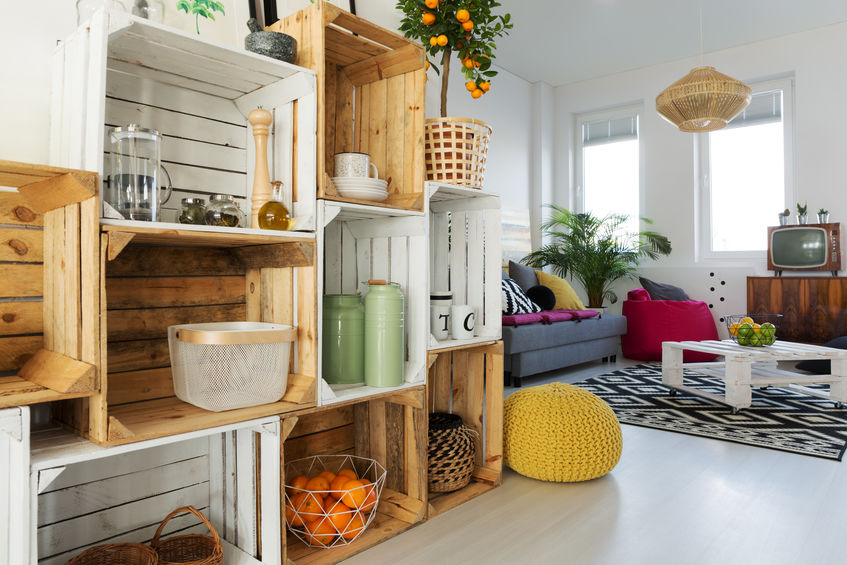
The solution isn't necessarily more storage.
Before you buy another basket, cabinet, or clever storage ottoman, figure out what actually belongs in the living room—and what doesn't.
That's where a clutter-free living room begins.
Step 1: Remove Everything That Belongs Somewhere Else
Start with the easiest clutter first.
Walk around the room with a basket or box and collect anything that clearly belongs elsewhere. That might include:
- Shoes.
- Clothing.
- Dishes and glasses.
- Mail.
- School papers.
- Toys that belong in bedrooms.
- Bathroom items.
- Tools.
- Shopping bags.
- Random things somebody carried into the room and abandoned.
Don't organize these things in the living room. Get them out. Put them where they belong.
This alone can make a surprising difference because living rooms tend to accumulate the belongings of every other room in the house.
Step 2: Declutter What Actually Belongs There
Now look at what's left.
These are the things that legitimately belong in the living room—or at least have a reasonable argument for being there. Go through them using four decisions:
Keep. Donate. Sell. Toss.
Ask yourself:
Do we actually use this in this room?
If yes, keep it. If no, why is it occupying living-room real estate?
You may discover books nobody intends to read again, decorative objects nobody particularly likes, old electronics, games nobody plays, abandoned hobby supplies, or enough throw pillows to construct emergency shelter.
You don't have to empty the room. You're simply removing the excess so the things you actually use have somewhere to go.
Need a bigger decluttering plan?
See How to Declutter Your Home Without Getting Overwhelmed →
Step 3: Clear the Flat Surfaces
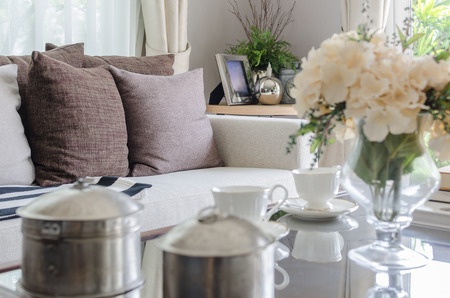
Living room clutter loves a flat surface.
- Coffee tables.
- End tables.
- Console tables.
- The top of the media cabinet.
Give your family an empty horizontal surface, and somebody will put something on it.
Then somebody else will add something. Soon you've got a small settlement. Clear each surface completely. Clean it.
Then decide what deserves to return.
A lamp? Certainly.
A coaster? Useful.
The remote? Probably.
Seven catalogs, two charging cables, yesterday's coffee cup, and a receipt from CVS? No.
Try to leave some actual empty space. A surface does not become unfinished merely because you can see part of it.
Step 4: Give Everyday Items a Home
Now comes the organizing part.
Anything you routinely use in the living room needs a specific place to live. Not "somewhere around the couch."
An actual place.
For example:
Remotes: One drawer, tray, or small container.
Chargers: One charging location or cord organizer.
Books: One shelf or designated section.
Magazines: One basket or holder—and a limit on how many stay.
Blankets: One basket, cabinet, or storage ottoman.
Games: One shelf or cabinet.
Pet toys: One container.
Children's toys: One defined area or set of bins.
The important part isn't what kind of container you buy. It's that everybody knows where the item goes when they're finished with it.
Step 5: Don't Buy Storage Until You Know What You're Storing
This is where organizing projects often get expensive.
You see clutter. You buy baskets. Now you have clutter and baskets.
Declutter first. Then look at what remains. Only then decide whether you actually need additional storage.
If you do, choose storage based on the problem you're trying to solve. Useful options might include:
- A coffee table with drawers.
- A storage ottoman.
- A console with closed cabinets.
- Baskets that fit existing shelves.
- A small tray for remotes.
- A lidded container for toys.
- Shelving for books or games.
Closed storage is particularly useful for visually busy items.
Not everything needs to be displayed. Sometimes the most attractive decorating decision is a door.
Step 6: Control Toy Creep
If children use the living room, toys will appear there. This is normal.
Your living room doesn't need to pretend that children live somewhere else. But the toys need boundaries. Give living-room toys a specific amount of space.
Maybe that's:
- One basket.
- Two bins.
- One cabinet.
- One shelf.
When that space is full, something has to leave before something new comes in.
Don't turn the living room into overflow storage for every toy your children own.
Keep the things they genuinely use there and return the rest to bedrooms, playrooms, or wherever you've decided toys belong.
For younger children, simple categories usually work better than elaborate systems. Blocks. Cars. Art supplies. Games. Stuffed animals.
If cleanup requires a 14-category sorting procedure, nobody will do it.
See Easy Toy Storage Solutions →
Step 7: Stop Paper at the Door
Living rooms are remarkably good at turning into paper storage facilities. Mail lands on the coffee table. School papers arrive. Receipts appear. Forms wait for signatures.
Before long, you're moving piles from one end of the table to the other whenever you want to put down a drink.
Create one place for incoming papers somewhere else if possible. Mail should have a processing spot. School papers should have a home.
Put documents requiring action into whatever system you use for paperwork.
The coffee table should not be your filing cabinet. If papers routinely accumulate in the living room, don't keep tidying the pile. Fix the paper's route through the house.
See How to Organize Paperwork →
Step 8: Deal With the Cord Jungle
Modern living rooms have acquired a new species of clutter: cables.
- Phone chargers.
- Laptop chargers.
- TV cables.
- Gaming systems.
- Speakers.
- Streaming devices.
Nobody knows what half the cords do, but we're afraid to unplug any of them in case the entire house stops functioning.
Start with the easy ones. Remove cables connected to devices you no longer use. Bundle or route permanent cords so they're less visible.
Give frequently used chargers one designated location. Label cords when several similar ones disappear behind furniture or electronics.
And before keeping an unidentified cable forever, see whether you still own anything it fits. You may be preserving the charger for a phone you owned in 2014.
It has served its country.
Step 9: Give Each Person a Landing Spot
People tend to sit in the same places. Use that instead of fighting it.
If someone reads in the same chair every night, put book storage nearby. If somebody always charges a tablet beside the couch, create a charging spot there.
If your child draws at the coffee table, keep a small amount of art material somewhere accessible.
Organize around what people actually do, not around what you wish they did.
A system located where an item is used has a much better chance of surviving.
Step 10: Be Selective About What You Display
Living rooms often slowly accumulate decorative clutter.
- A framed photo appears.
- Then another.
- A souvenir.
- A vase.
- A candle.
- Three more photos.
- Something inherited.
- Something somebody gave you.
Eventually every shelf is full, yet nothing stands out. You don't have to display everything you own.
Choose the things you genuinely enjoy seeing. Give them some breathing room. Rotate decorative items if you like having more than you can comfortably display at once.
And don't assume something deserves permanent shelf space because it was a gift.
The shelf is yours now.
Step 11: Don't Use the Living Room as Temporary Storage
Temporary storage has an unfortunate habit of becoming permanent.
The box you're taking to Goodwill.
The package you're returning.
The bag going upstairs.
The things you're giving your daughter.
The stack you're going to "deal with later."
Later needs a deadline. If something is leaving the house, move it toward the exit.
Put donations in the car or designated donation area. Put returns with your keys or shopping bags. Carry upstairs items upstairs.
Don't create a living-room departure lounge for possessions.
Step 12: Fix the Clutter Hotspots
After you've decluttered, pay attention to where clutter starts rebuilding. That spot is giving you useful information.
If shoes repeatedly collect beside the couch, ask why.
If mail keeps appearing on the coffee table, your paper system isn't convenient enough.
If blankets are always piled on a chair, the blanket basket may be too far away.
If toys never make it back upstairs, perhaps some living-room toy storage makes sense.
Don't repeatedly clean up the same problem without examining what's causing it. The goal isn't to become better at picking things up.
It's to create a room that requires less picking up.
Step 13: Do a Five-Minute Living Room Reset
Once you have the room under control, keeping it that way shouldn't require another decluttering project.
At the end of the day—or whenever works for you—give the room five minutes.
- Return dishes to the kitchen.
- Toss trash.
- Fold blankets.
- Put remotes back.
- Return toys to their containers.
- Take wandering items to their rooms.
- Clear the coffee table.
- Straighten cushions.
That's it. You're not cleaning the room from top to bottom. You're resetting it.
Five minutes tonight is much easier than excavating the room next Saturday.
What Should Stay in a Living Room?
There is no universal list. Your living room should include what supports how your household uses it.
That might include:
- Comfortable seating.
- Lighting.
- Books.
- Television or entertainment equipment.
- Games.
- Blankets.
- A limited number of toys.
- Pet supplies.
- Decorative items you actually like.
Someone else's perfectly styled living room doesn't matter.
If your family plays board games every Friday night, the games belong there.
If nobody in your house reads magazines, you don't need a magazine basket because an organizing article told you to buy one.
Your room needs to work.
What Shouldn't Stay in the Living Room?
Start questioning things that:
- Belong in another room.
- Nobody uses.
- Nobody likes.
- Are broken.
- Have been waiting for repair indefinitely.
- Exist only because nobody has decided what to do with them.
- Make everyday cleanup harder.
Those objects quietly turn a functional room into a storage area.
If Your Living Room Is Really Cluttered, Don't Empty Everything at Once
This is especially important.
You don't need to drag every object into the middle of the floor to prove you're serious about decluttering.
That can turn one cluttered room into one spectacularly worse cluttered room. Work in small sections.
Start with:
- Coffee table.
- End tables.
- Floor.
- Sofa and chairs.
- Media area.
- One shelf or cabinet at a time.
Finish one area before opening another. Visible progress creates momentum.
A room that looks as though it was burglarized does not.
The 15-Minute Living Room Rescue
If company is coming—or you've simply had enough—set a timer for 15 minutes.
First five minutes: Remove trash, dishes, and items that belong in other rooms.
Next five minutes: Put away living-room items and clear the main surfaces.
Final five minutes: Straighten cushions and blankets, then vacuum or sweep the most visible area if needed.
Stop when the timer goes off. You've improved the room.
You don't need to reward yourself by cleaning another one.
The Real Secret to a Clutter-Free Living Room
It isn't buying better storage. It's having less unnecessary stuff in the room and making what remains easy to put away.
Declutter first.
Give everyday items obvious homes.
Create boundaries for toys and papers.
Organize around the way your family actually lives.
Then reset the room for a few minutes each day.
Your living room doesn't have to look like nobody lives there.
It should look like people can live there—comfortably, without moving twelve things before they can sit down.
That's a much more useful definition of clutter-free.
Keep Going
How to Declutter Your Home Without Getting Overwhelmed →
How to Organize Your Home Room by Room →
Ready to Declutter More Than the Living Room?
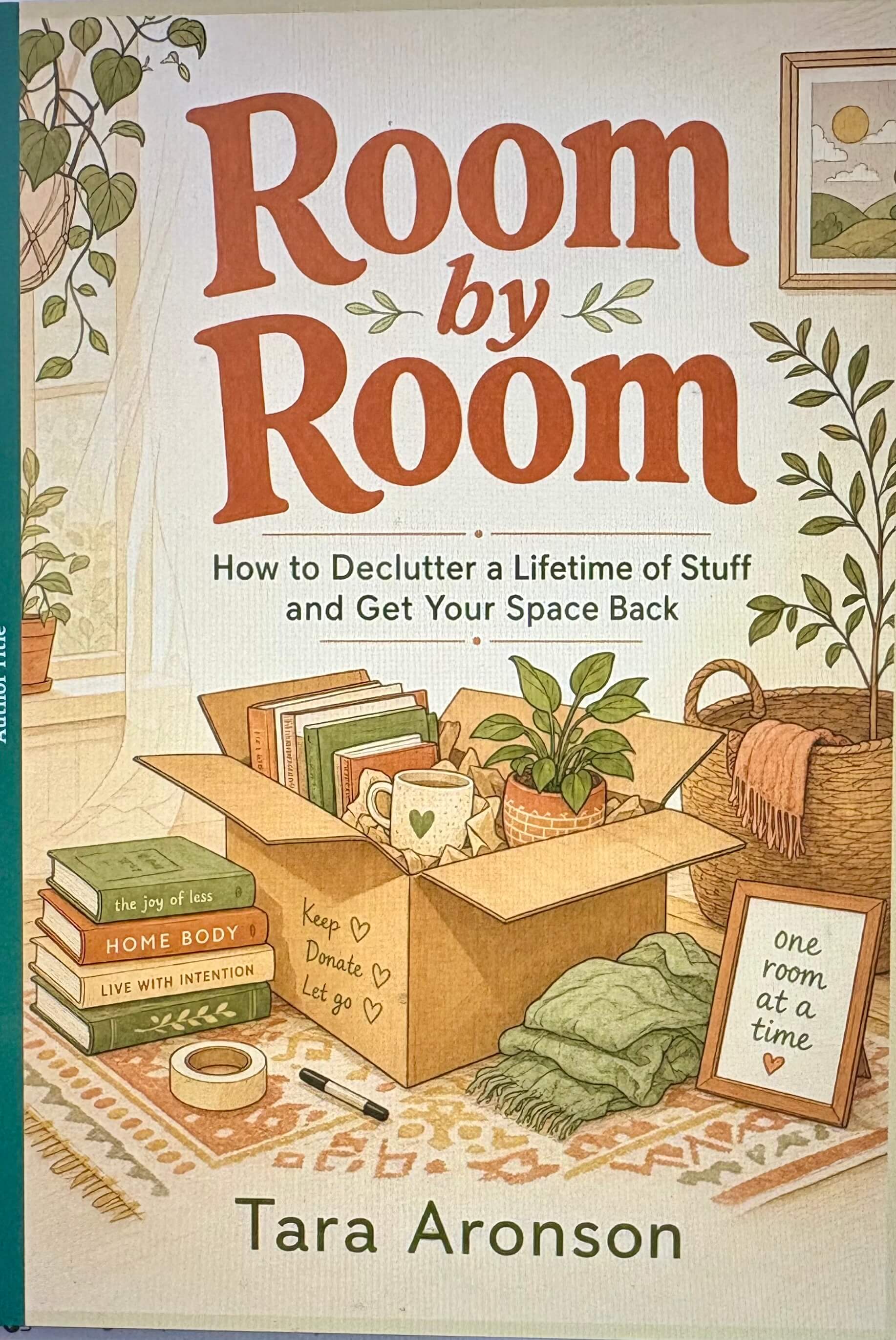
If the living room is only the beginning, Room by Room by Tara Aronson walks you through decluttering your home one space at a time—without turning the process into a weekend-long purge or demanding that you become a minimalist.
Learn more about Room by Room →
- Clean Home
- Organize Your Home
- Clutter Free Living Room