Living Room Organization Ideas
for a More Functional Space
Living rooms have one major organizational problem:
Everybody uses them.
One person is watching TV. Someone else is charging a phone. A child is doing homework. A dog has claimed the best chair. Books, blankets, remotes, game controllers, drinks, and at least one object nobody can explain.
And most living rooms weren't designed to store any of it.
You get a sofa.
A coffee table.
A couple of chairs.
Perhaps an end table.
Very nice.
Now where do you put everything people actually use? The answer isn't to turn the room into a wall of storage cabinets.
It's to organize the space around how your family actually lives in it.
That means giving frequently used things convenient homes, creating a few simple activity zones, and making cleanup easy enough that people might actually do it.
Declutter Before You Organize
Before you organize the living room, remove the things you no longer want or use.
Otherwise, you're simply finding better places to store excess stuff.
Go through:
- Books.
- Games.
- Electronics.
- Decorative items.
- Toys.
- Blankets.
- Magazines.
- Old cables.
- Furniture.
Keep what belongs in the room and earns its space.
Move items that belong elsewhere.
Donate or sell what you no longer need.
Toss anything broken or unusable.
Once you've reduced what you're dealing with, organization becomes much easier.
If the room is still overloaded, start with How to Declutter Your Living Room—and Keep It That Way →
Organize Around What Happens in the Room
Forget how a showroom says a living room should function.
Look at what actually happens in yours.
Do people:
- Watch television?
- Read?
- Play games?
- Work on laptops?
- Do homework?
- Play with toys?
- Nap?
- Entertain?
- Fold laundry?
- Spend time with pets?
Your storage should support those activities.
If everybody reads in the same chair, keep books nearby.
If children play on the floor, keep toy storage close to the play area.
If people charge devices beside the sofa, put a charging solution there.
Good organization reduces unnecessary movement.
If you constantly carry the same item across the room to put it away, its assigned home may be in the wrong place.
Give Remotes One Home
Remote controls are tiny, expensive objects apparently designed to disappear into upholstery.
Give them one location.
That could be:
- A small tray.
- A drawer.
- A basket.
- A compartment in a coffee table.
- A side-table organizer.
The exact container doesn't matter.
Consistency does.
If everybody knows the remote goes in the same place, you spend less time asking who had it last.
This also works for game controllers.
One home.
Every time.
Revolutionary.
Create a Charging Station
Phones, tablets, headphones, and laptops have added a whole new category of living-room clutter.
The cables alone can make a tidy room look as though somebody is rebuilding the electrical grid.
Choose one charging area if possible.
Use:
- A charging dock.
- A small basket.
- Cord clips.
- A drawer with cable access.
- A side table near an outlet.
Keep only the charging cords you actually use.
Label similar cords if necessary.
And get rid of chargers for devices you no longer own.
Your old flip phone has moved on.
You may too.
Store Blankets Where They're Used
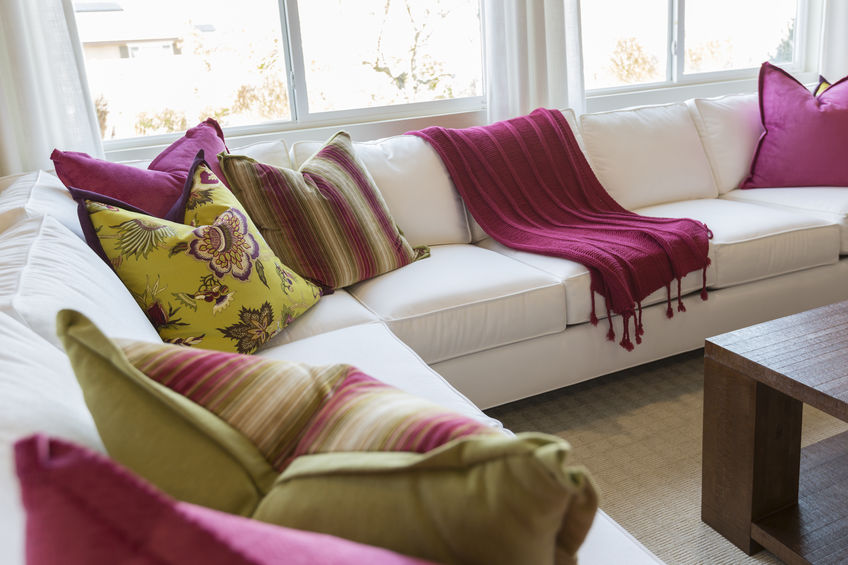
Blankets don't need an elaborate storage system.
They just need to be close to the sofa.
Options include:
- A basket.
- A storage ottoman.
- A bench with storage.
- A cabinet.
- One designated section of a closet.
Choose a space big enough for the number of blankets you realistically use.
If the basket can hold four blankets and you own fourteen, the problem is no longer the basket.
Organize Books Without Turning the Room Into a Library Annex
Keep the books people are currently reading or genuinely want nearby.
Arrange them on:
- Bookshelves.
- Built-in shelves.
- A cabinet.
- A small basket beside a reading chair.
You don't need to keep every book you've ever owned in the living room.
If shelves are packed so tightly that adding one paperback causes structural tension, it's time to edit.
Leave some space.
Shelves work better when you can actually put something away without rearranging the entire collection.
Give Toys Clear Boundaries
Family living rooms often double as playrooms.
That's fine.
The goal isn't to pretend children don't live there. The goal is to stop the toys from taking over.
Give living-room toys a defined amount of space.
Maybe:
- One basket.
- Two bins.
- One cabinet.
- One shelf.
- The lower section of a bookcase.
Use broad categories rather than overly complicated ones.
For example:
- Blocks.
- Cars.
- Art supplies.
- Games.
- Stuffed animals.
You probably do not need separate containers for red cars, blue cars, construction vehicles, and cars that have experienced emotional growth.
Simple systems get used.
See Easy Toy Storage Solutions →
Use Furniture That Earns Its Space
In a room short on storage, furniture should occasionally do more than one job.
Useful options include:
- Coffee tables with drawers.
- End tables with shelves.
- Storage ottomans.
- Benches with hidden storage.
- Media cabinets with doors.
- Bookcases.
- Console tables with drawers.
- Built-in shelving.
You don't need to replace all your furniture.
But when you eventually do replace something, consider whether the new piece could solve a storage problem at the same time.
A coffee table with drawers may be more useful than one that simply offers a lovely open surface for accumulating clutter.
Use Closed Storage for Visual Clutter
Some things look messy even when they're technically organized.
Cables.
Games.
Toys.
Craft supplies.
Electronics accessories.
Pet supplies.
These are often better behind a door, inside a drawer, or in a basket.
Open shelving works beautifully for books and a few decorative items. It works less beautifully for forty-seven miscellaneous charging cables.
Closed storage gives visually busy items somewhere to disappear.
Sometimes organization means knowing what not to display.
Keep Frequently Used Items Within Reach
Store things close to where you use them.
This sounds obvious.
It is also one of the most frequently ignored organizing principles.
If you watch TV from the sofa, keep the remote nearby.
If you read in the armchair, keep books and glasses nearby.
If your child colors at the coffee table, keep a small set of art supplies nearby.
If you always use a blanket on one end of the sofa, keep the blanket basket close.
Don't store things according to where they look best.
Store them where people will actually put them back.
Give Every Family Member a Small Personal Space
A shared room often needs some personal storage.
Give each person a small, defined area for frequently used items.
That might be:
- One drawer.
- One basket.
- One cubby.
- One section of a cabinet.
Use it for things such as:
- Current books.
- Headphones.
- Tablets.
- Chargers.
- Small hobbies.
- Notebooks.
The key word is small.
This is not permission to establish a private warehouse beside the sofa.
It's simply a place for the handful of things someone regularly uses in the room.
Create a Reading Area
If someone reads regularly, make it easy.
You need:
- Comfortable seating.
- Good lighting.
- A place for the current book.
- Somewhere to set glasses or a drink.
That's enough.
You do not need to create a Pinterest reading sanctuary involving a ladder, twelve pillows, and a hand-lettered sign announcing that books are magical.
A chair and a lamp will do.
Organize the TV and Gaming Area
Entertainment systems create clutter quickly.
Keep only the equipment you use.
Then organize:
- Remotes.
- Controllers.
- Headphones.
- Games.
- Streaming devices.
- Cables.
Use drawers, cabinets, or labeled containers. Run cords neatly behind furniture when possible.
Don't keep obsolete equipment because you might someday need the cable.
If the device it connected to disappeared three televisions ago, you probably won't.
Make Room for Homework or Laptop Use
Many living rooms now double as workspaces.
If people regularly work there, create a small system for the supplies.
That could include:
- Laptop.
- Charger.
- Notebook.
- Pens.
- Headphones.
Store them together. When the work session ends, everything goes back to the same place.
This prevents the coffee table from slowly becoming a satellite office.
Keep Pet Supplies Contained
Pet toys have mastered the same expansion strategy as children's toys.
Give them a limit.
One basket is usually enough for frequently used toys.
Store grooming supplies, leashes, and other pet equipment elsewhere unless you actually use them in the living room.
If your dog has eighteen nearly identical tennis balls in the room, you are no longer organizing.
You are managing inventory.
Don't Overorganize
An organizing system can be too complicated.
If putting something away requires:
- Opening a cabinet.
- Moving another container.
- Removing a lid.
- Sorting the object.
- Replacing the lid.
- Putting the container back.
Guess where the object will end up? On the coffee table.
Make frequently used storage easy.
Open baskets, accessible drawers, and simple shelves often work better than elaborate systems.
Save the complicated storage for items you rarely use.
Make Cleanup Obvious
Good organization should tell people what to do.
A blanket basket says:
Blankets go here.
A remote tray says:
Remotes go here.
A toy bin says:
Toys go here.
A shoe basket says:
Apparently you insist on removing your shoes here, so fine. Put them here.
The less thinking required, the more likely the system is to survive everyday life.
Watch for Storage Creep
Storage doesn't solve every clutter problem.
Sometimes additional storage simply creates additional capacity for keeping things.
If every cabinet is full, every basket is overflowing, and every shelf is packed, don't automatically buy another storage unit.
Look at what you're storing.
Organization works best when there is some breathing room.
You should be able to remove and replace items without wrestling with the container.
If the storage system is difficult to use, it isn't really organized.
It's packed.
Small Living Room? Think Vertically
In a small room, floor space is valuable.
Consider vertical storage such as:
- Tall bookcases.
- Wall-mounted shelves.
- Cabinets.
- Built-ins.
Use wall space strategically without covering every available inch.
You still want the room to feel like a living space, not the records department.
Choose storage that solves a specific problem. More shelving isn't automatically better.
Use Baskets Carefully
Baskets can be useful.
They can also become attractive places to hide things you don't want to deal with.
Use baskets for defined categories. For example:
Good: blankets.
Good: pet toys.
Good: children's toys.
Good: current magazines.
Less good: miscellaneous things nobody knows what to do with.
That's not storage. That's a postponement container.
If you own a mystery basket, empty it.
Decide what everything is.
Then give those things real homes.
Don't Turn Every Wall Into Storage
Living rooms need visual space too. You don't have to maximize every inch.
A room can technically hold more storage and still be better without it.
Leave room for:
- Empty wall space.
- Open surfaces.
- Comfortable movement.
- A few objects you enjoy seeing.
Organization is not about squeezing the maximum number of possessions into a room.
It's about making the room easy to use.
Create a Five-Minute Reset
Once the room is organized, maintenance should be simple.
At the end of the day, spend five minutes resetting it.
- Put remotes away.
- Return toys to bins.
- Fold blankets.
- Remove dishes.
- Put books back.
- Clear the coffee table.
- Plug devices into the charging area.
- Take items belonging elsewhere with you.
Five minutes is enough because the room already has systems.
Without systems, cleanup requires deciding where everything should go.
With systems, you already know.
If Something Never Gets Put Away, Change the System
This is one of the most useful organizing rules in the entire house.
If the same item keeps ending up in the same wrong place, don't simply blame the person leaving it there.
Ask why.
Maybe the assigned storage is:
- Too far away.
- Too full.
- Hard to reach.
- Too complicated.
- In the wrong room.
If everybody throws blankets over the sofa instead of putting them in a basket across the room, move the basket closer.
If chargers always accumulate beside one chair, that's probably where the charging station belongs.
Your family's habits are information. Use them.
The Goal Isn't a Perfect Living Room
A living room is supposed to be lived in.
There will be blankets.
There may be toys.
Someone will leave a glass on the table.
The point of organization isn't to eliminate all evidence of human activity.
It's to make returning the room to order quick and easy.
Declutter what doesn't belong.
Store things where they're used.
Keep the systems simple.
Give everyone clear places for everyday items.
And leave enough empty space for the room to actually function.
That's organized.
Not because nothing is ever out of place.
Because putting it back doesn't require a committee meeting.
Keep Organizing
How to Organize Your Home Room by Room →
How to Declutter Your Living Room—and Keep It That Way →
How to Declutter Your Home Without Getting Overwhelmed →
Weekly Home Cleaning Routine →
Want Help With the Rest of the House?
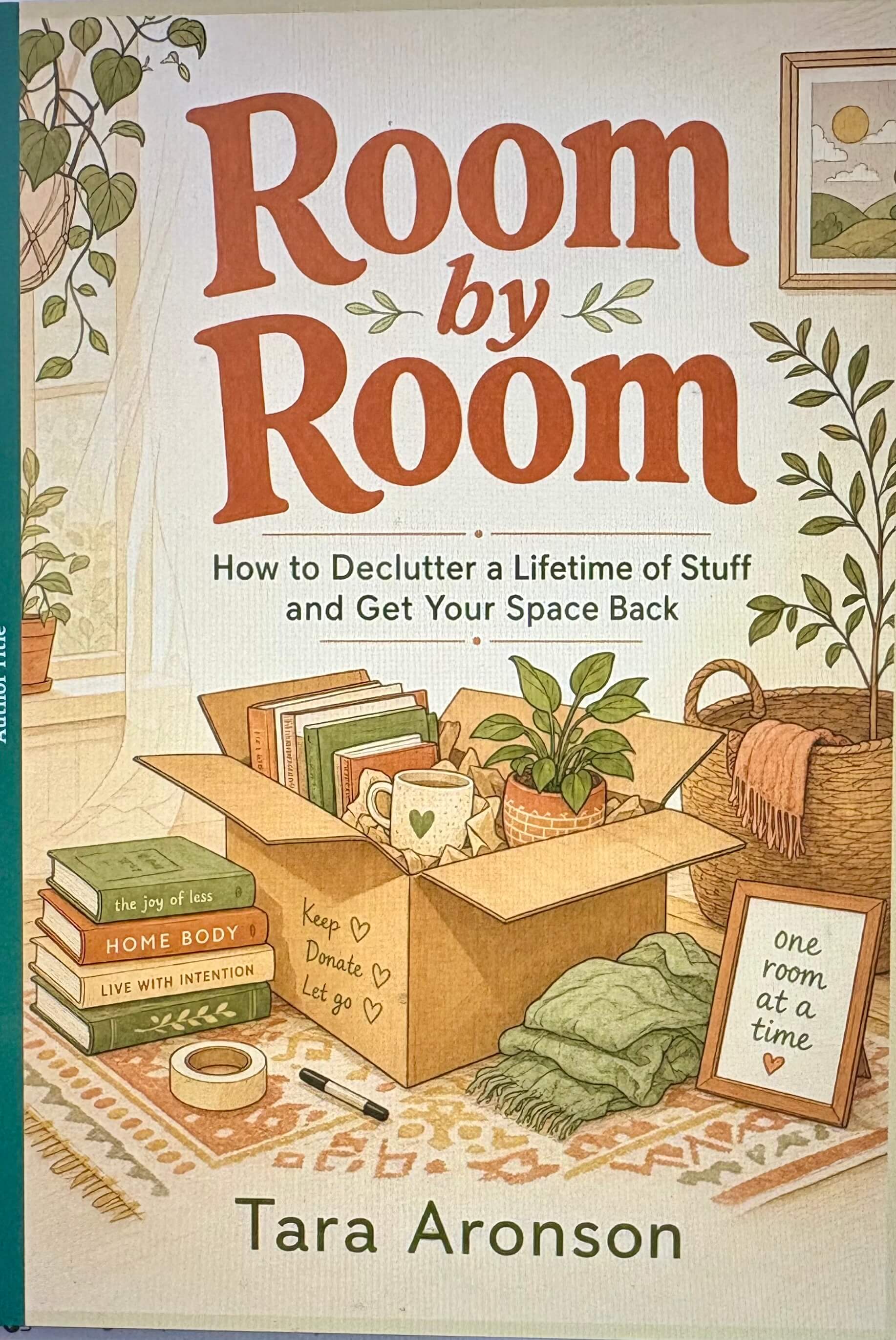
Room by Room by Tara Aronson takes you through the house one space at a time, helping you declutter what you don't need and build practical systems for what remains—without a minimalist makeover.
Learn more about Room by Room →
- Clean Home
- Organize Your Home
- Living Area Organizing